

Watch professional golfers play just a hole or two and you’re bound to identify at least a half dozen ways in which their games are unrecognizable to that of the average amateur. A perfect example? The ways in which they coolly extricate themselves from greenside bunkers. Their escape-artist skills are Houdini-like, so much so that the pros almost always hope to find the sand on offline approach shots. Landing in a greenside bunker could be catastrophic for the average player, but for the world’s best, the sand represents their best chance for successful recovery.
Of course, there are a few exceptions.
Every so often, golfers of all ability levels will come across a greenside bunker so menacing that the mere thought of standing in it with a wedge in hand is terrifying. These are the ones that even the pros go out of their way to avoid. While there are plenty of traps out there that could land on most golfers’ lists of the deepest and most treacherous, here we spotlight eight—four on each side of the Atlantic—that are bound to strike fear in the hearts of players all around the world.
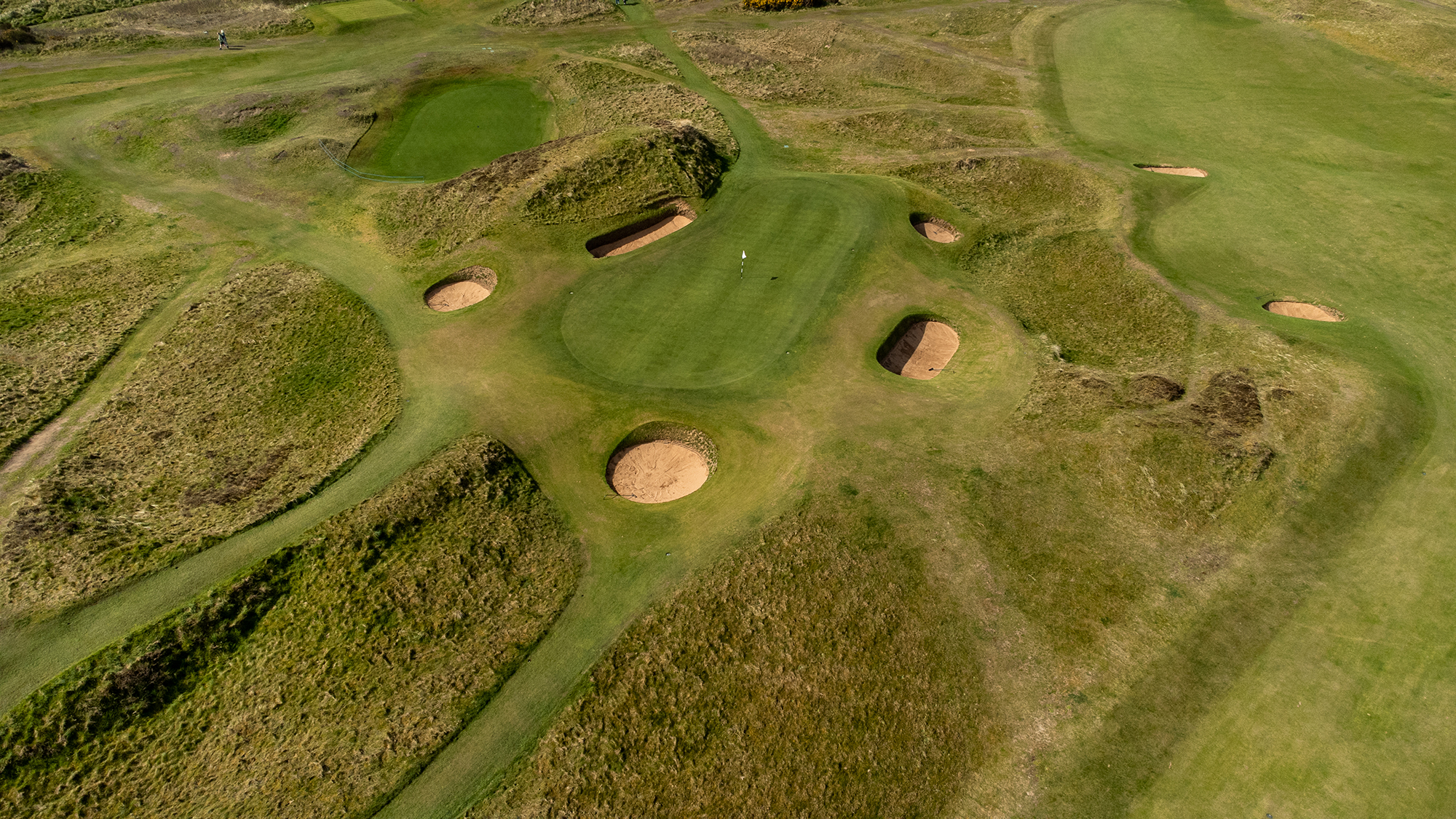
8th Hole, Royal Troon Golf Club—Troon, Scotland
When you hear a bunker is nicknamed “Coffin,” well, you know how catastrophic hitting a ball into it can be. That particular trap, positioned on the high side of the green to the left of the putting surface on Royal Troon’s “Postage Stamp,” the par-three 8th, may be the most famous of the five that surround the hole, but it’s not the deepest of the bunch. That accolade, such as it were, belongs to the bunker on the right, which is effectively twice its actual size given that all of the tightly mown turf around it is canted to funnel balls into its sandy abyss. Consider this: back in 2016, during a practice round for the Open Championship, Rory McIlroy needed six shots to extricate himself from that bunker for good. Six! If the bunker on the opposite side is called the Coffin, this one should be known as the Card Wrecker.
6th Hole, Whistling Straits (Straits)—Sheboygan, Wis.
Considering the Straits course at Whistling Straits features close to 1,000 bunkers strewn across its almost 7,800 yards of play, it’s easy to understand why individual traps aren’t likely to get much attention on their own. That said, the par-four 6th hole is home to one devilish bunker that must be avoided at all costs. Moreover, it’s so fiendishly small (in surface area), that players might not even recognize the impending doom that it can impart. Responsible for the hole’s name, Gremlin Ear, the bunker is one of 10 that guard the front and right side of the putting surface, but it’s cut just a bit different than all the rest, with an almost vertical face that’s more than six feet tall. You likely don’t have a wedge in your bag with enough loft to comfortably extricate yourself from those sandy confines, should you end up there, which is why if the hole is cut on in the front middle of this green on the day you play the Straits, it’s a fool’s errand to go chasing it.

15th Hole, Royal Liverpool Golf Club—Hoylake, England
The word “deep” takes on multiple meanings on the short par-three 15th hole, “Little Eye,” at Royal Liverpool, which incidentally last played as the 17th hole when the club hosted the Open Championship in 2023. Steep-faced pot bunkers left and right, as well as a sprawling bunker guarding the front, all make for challenging recoveries, especially considering the severe slopes along the edges of the green that easily funnel balls back into the sand. The most perilous is the one positioned on the right of the green, which has garnered the nickname “Black Hole.” Set 10 feet below the putting surface, its gravitational pull is menacing, matched only by the bunker’s ability to sabotage good rounds.

6th Hole, Pacific Dunes—Bandon, Ore.
Playing a touch longer than 300 yards from the tips, the 6th hole at Pacific Dunes presents plenty of options off the tee. For longer hitters, the temptation to drive the green is strong; and while the elevated green is extremely narrow (and features a steep run-off area on the right), it’s not impossible to do it. The odds of accomplishing this feat, however, are low. The bigger issue is the cavernous greenside bunker on the left. Tom Doak’s sandpit of doom on Pacific Dunes’s 6th is both deep and expansive. If you’re not convinced of the dangers that lurk left of the green on this hole, consider the yardage guide’s advice: “If you find the left greenside bunker, the best bet is to play out sideways.”

14th Hole, Royal Portrush Golf Club (Dunluce)—Portrush, N. Ireland
It’s not often you encounter a hit-and-hope scenario from the middle of the fairway, but that’s how many players feel while standing on the short grass and assessing their options to the narrow green on the long par-four 14th hole at Royal Portrush. It all stems from a 10-foot-deep bunker guarding the left side of the putting surface. Based on how the green complex repels shots hit to its edges—and funnels shots hit on the left side toward the aforementioned bunker—the putting surface effectively plays only 70 percent of its actual size. A quick glance at the yardage guide tells you all you need to know: “Avoid the big bunker to the left of the green at all costs.”
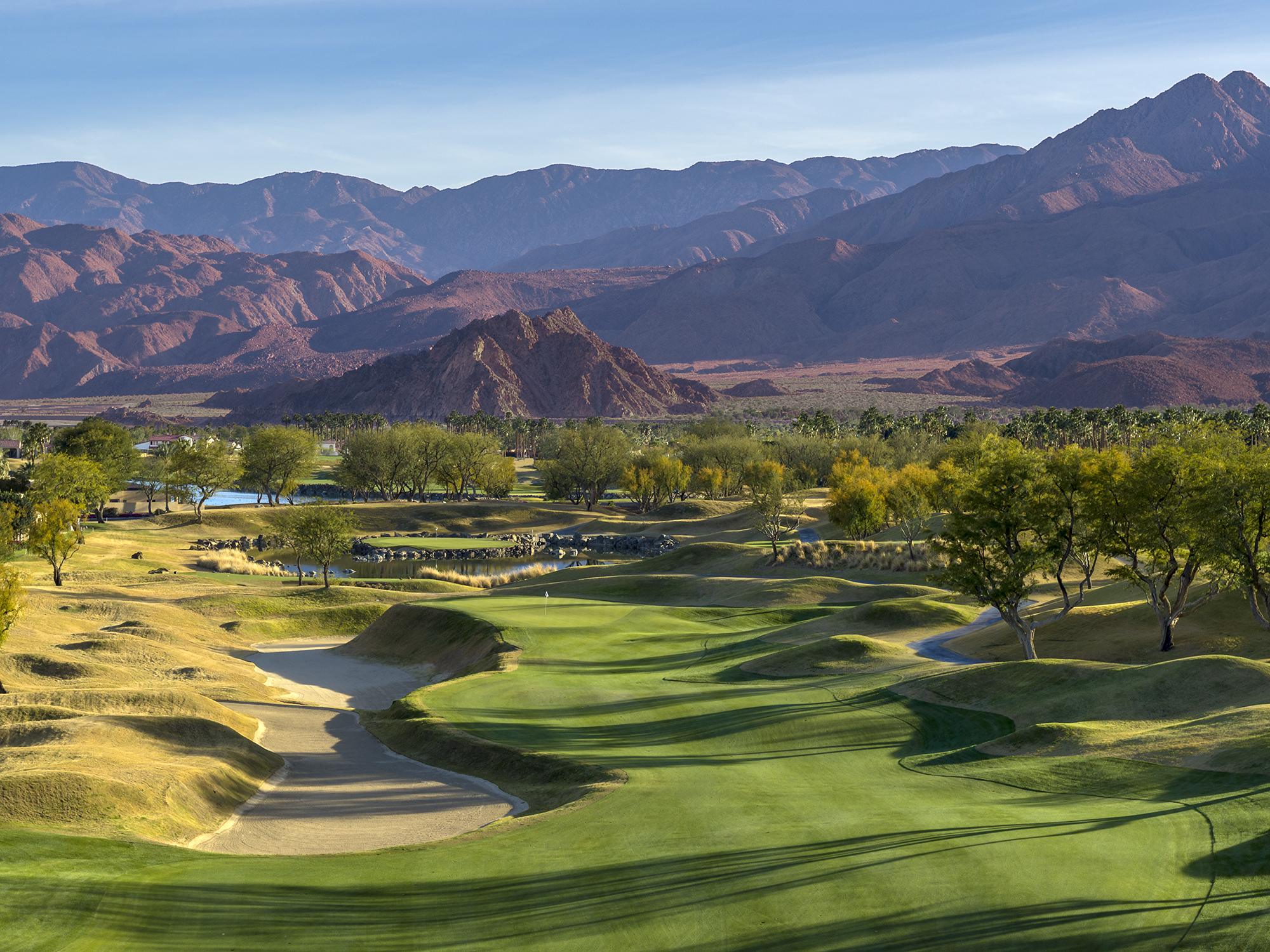
16th Hole, PGA West (Stadium)—La Quinta, Calif.
Yes, it’s an obvious choice, but the trap on the Stadium’s 16th hole at PGA West is effectively the poster child for deep, fear-inducing greenside bunkers. It’s also an architectural feature that strongly adheres to one of Pete Dye’s most famous idioms: “Golf is not a fair game,” he once declared, “so why build a course fair?” Shallowing out almost 20 feet below the surface of the green, the bunker introduces such a unique recovery shot that most players have likely never practiced it before. Evidence of that can be seen in some of the lowlights from rounds played during The American Express on the PGA Tour, when even the pros have found themselves hitting second and third attempts from the sand. The yardage guide warns that “getting out of this bunker could take some time,” and the best players in the world annually prove it.
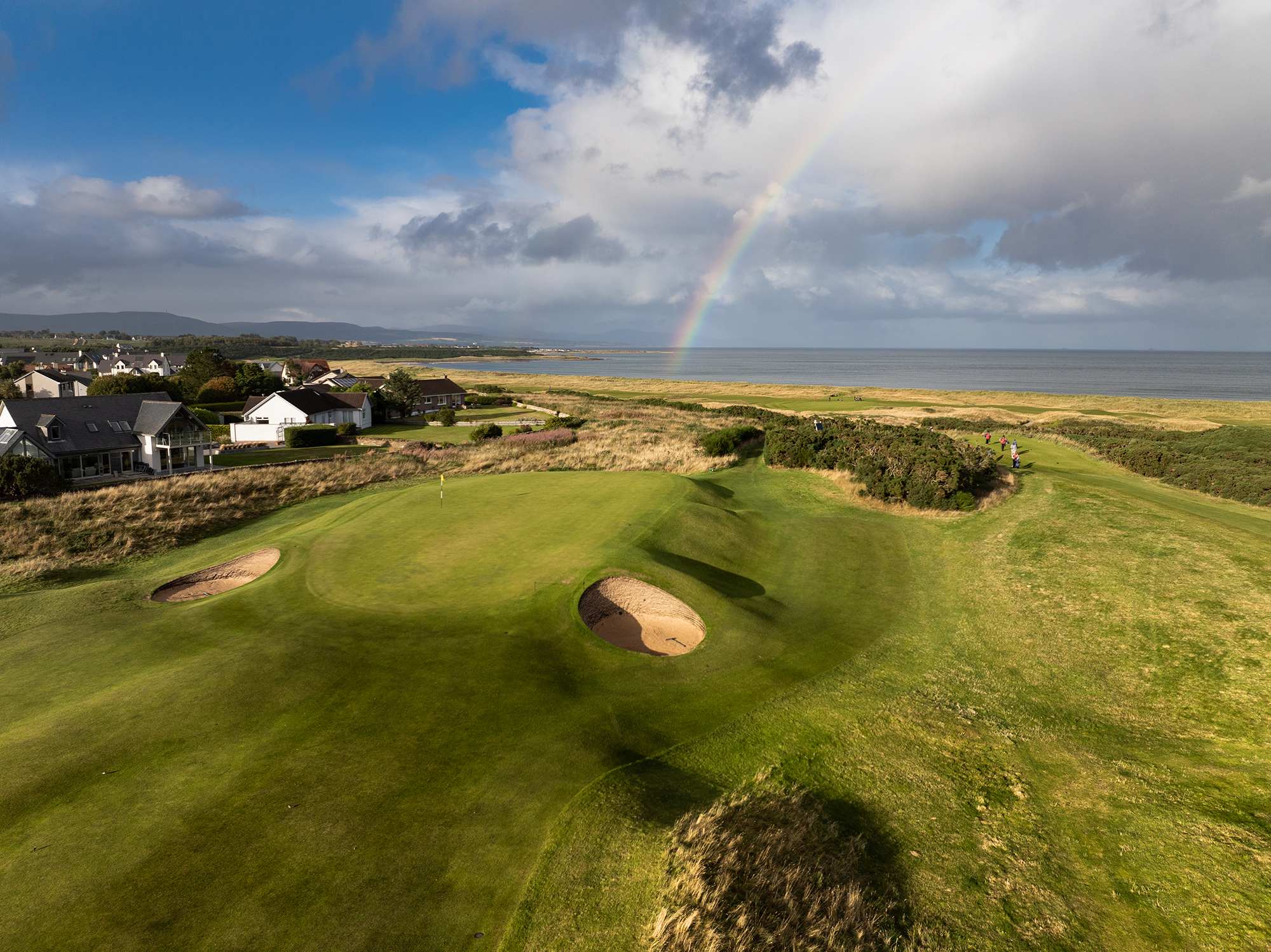
2nd Hole, Royal Dornoch Golf Club (Championship)—Dornoch, Scotland
Playing just under 190 yards, the first par three at Royal Dornoch is notorious for its two greenside bunkers that guard both front corners of the putting surface. The trouble is the grassy mounding positioned in between those two traps is strategically shaped to kick balls into either of those bunkers. From there, golfers are in for a challenge, as those bunkers are some of the deepest and most penal on the course. “There’s an old saying that ‘toughest shot at Royal Dornoch is your second to the 2nd,’ says Daniel Jones, the member engagement manager for Haversham & Baker Expeditions. “It’s a curious phrase given that the hole is a par three. But if you find either of the bunkers short of the green, you’ll understand why.”
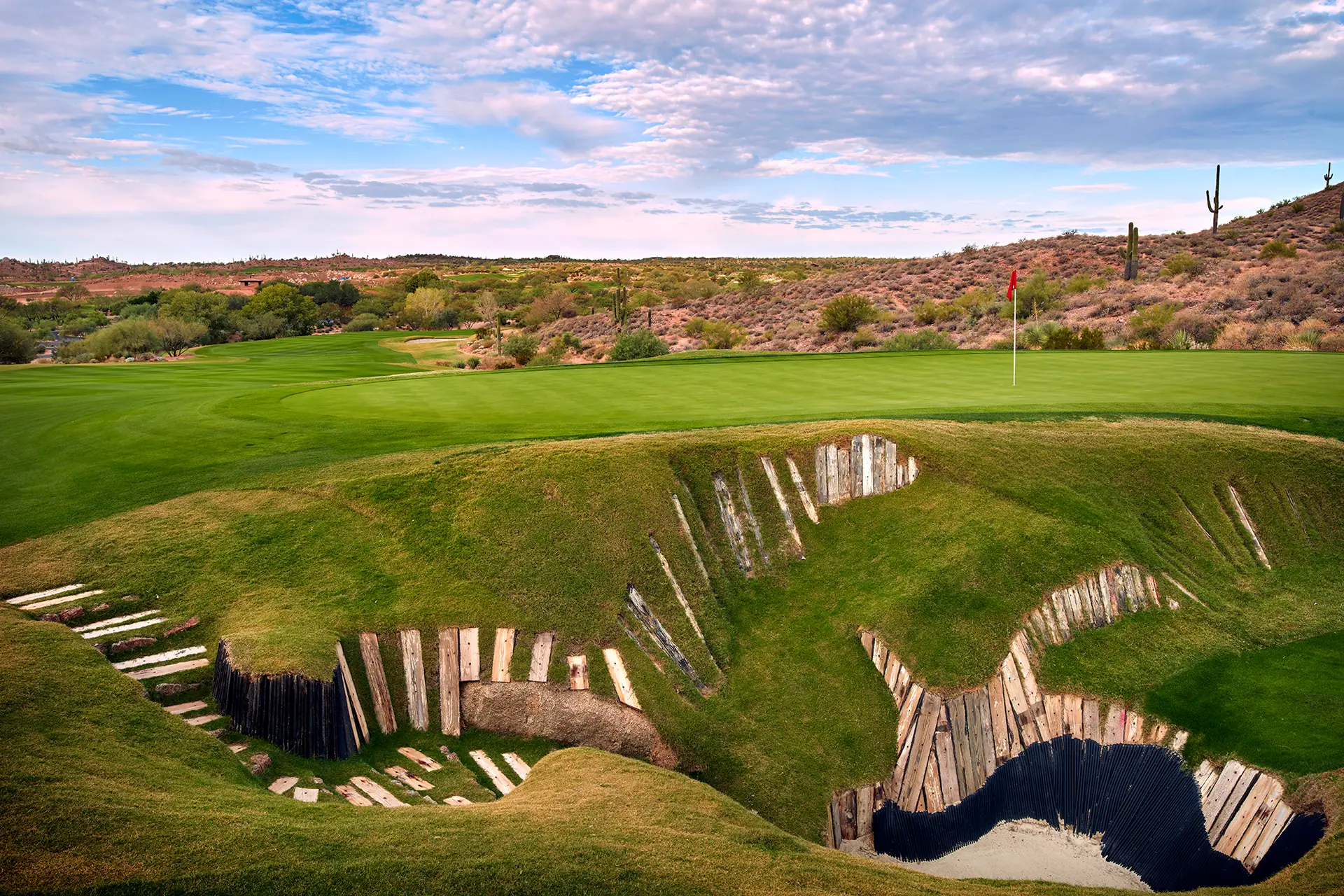
15th Hole, Scottsdale National Golf Club (The Mine Shaft Course)—Scottsdale, Ariz.
It’s not often a golf course is named for an architectural feature found on a single hole, but that’s how the original course at Scottsdale National—The Mine Shaft Course—got its name. Not long after PXG founder Bob Parsons acquired the golf club, he commissioned Jackson Kahn Design to renovate and, where necessary, redesign the club’s original routing. Behind the green on the par-five 15th hole, the design firm’s team started digging. The original mine shaft bunker that they created sunk eight feet below the putting surface. A year later, it stretched a foot-and-a-half deeper. You see, once Parsons learned that someone had escaped from the bunker on the first try, he ordered it to be dug deeper. Today? Well, that perilous pit of despair sits 13 feet below the green. If you’re lucky enough to tee it up at Scottsdale National, especially on the Mine Shaft Course, at all costs avoid going long with your approach shot. Trust us…should you find the sandy floor of that 13-foot bunker, you suddenly won’t feel so lucky.



I’d like to suggest the “Hogan Bunker” on #6 at Panmure Golf Club in Scotland.
How could you possibly leave out #10 at Pine Valley, “The Devil’s Asshole.“!