What has four wheels, LED lights, a custom paint job, GPS and tricked-out sound systems, and can go from golf course to the street?
Once upon a time, the golf cart was for, well, the golf course. Not anymore.
The golf cart (or car) is the transportation mode of choice at most golf communities. Take, for example, The Landings in Savannah, Ga., where about 85 percent of the 9,000 residents own their own cart—or two: It’s not unusual to fill the garage with a big six-seater for family outings as well as a two-seater for the course.
“It’s just a way of life here,” says Gary Lorfano, the director of membership, marketing, and communications at The Landings Golf & Athletic Club.
“You can go from one end of the island to the other in your cart. People roll up to the wellness center that way to play pickleball. There are no gas-powered carts, so there’s a little bit of an environmental factor, too.”
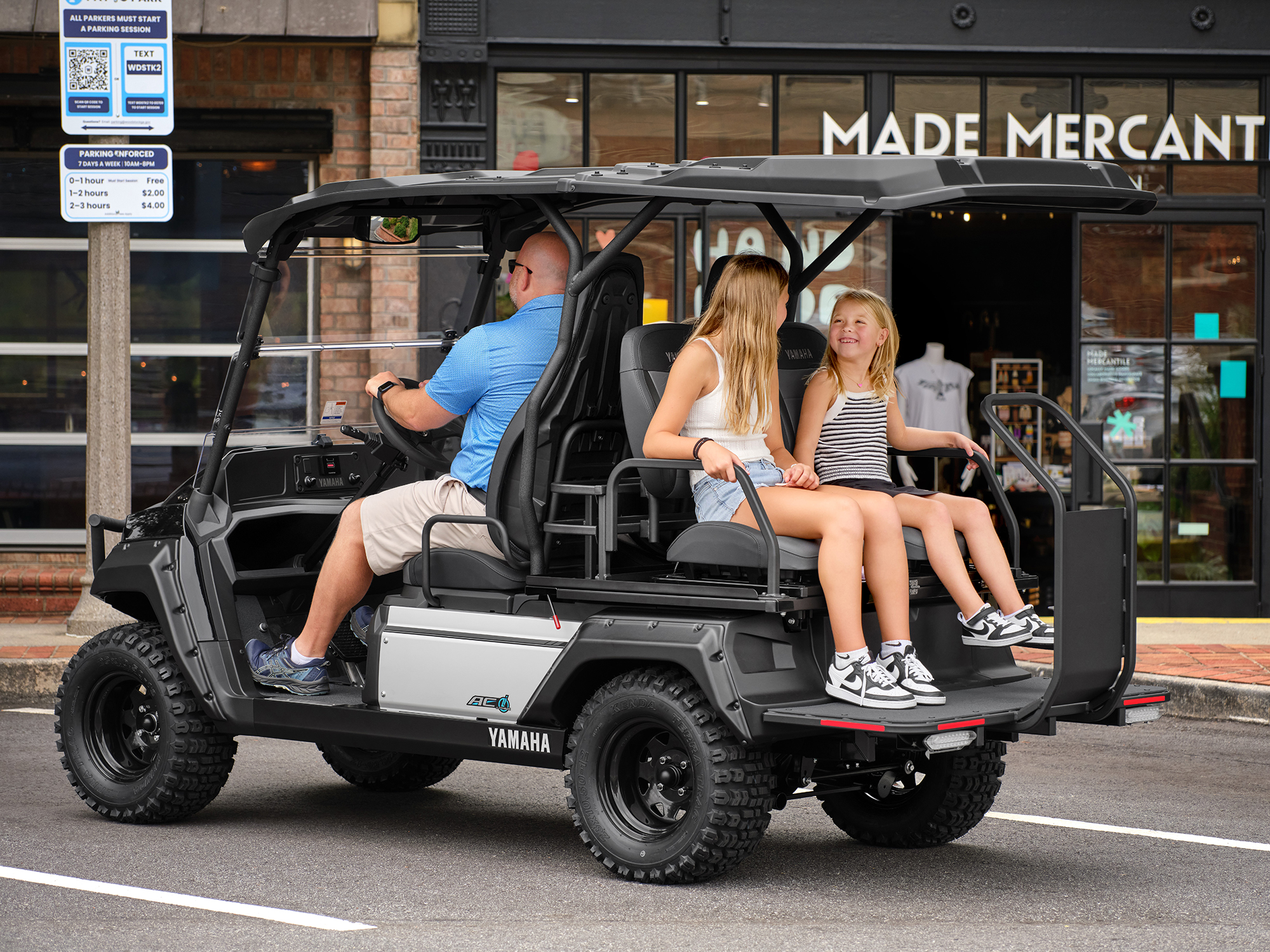
With dedicated golf cart paths spanning the entire eight miles of the property, residents zip around in their carts to one of the six courses, holiday events, or the village to do shopping and errands. The Publix grocery store even has dedicated golf cart parking spots.
“More people want to be outside, want experiential processes built into their day-to-day lives,” says Chase Sloan, Yamaha’s marketing manager for golf cars, “and it’s a good mode of transportation for them. Battery-powered or even from a gas perspective, it turns out to be cheaper in a lot of cases than driving around in an actual car. It’s a very good market to be in.”
“People like the convenience of smaller, easy-to-maneuver vehicles because they make getting around where they live, work, and play a breeze,” says Chris Lammie, senior manager, consumer portfolio at Club Car. “Today’s cars are more than carts pulled straight from the course; they’re purpose-built for neighborhoods, families, and fun. And they’re easy to personalize with options and details to suit your style and make routine rides exciting.”
It’s true: Owners love making their carts their own when they order them, with bold colors and premium seats, as well as custom lighting, wheels, sound systems, and clever storage solutions. And if they can’t order it, after-market custom golf cart services also abound.
This passion for personal transportation vehicles (PTVs, the “official” industry name) is a big reason Club Car—one of the big three manufacturers, along with Yamaha and E-Z-GO—sponsors a Korn Ferry Tour event at The Landings every spring.
“Every day, our customers share how the convenience of our cars keeps them active, mobile, and engaged,” adds Lammie. “The Landings showcases how golf cars drive a mobile-social lifestyle and foster a true sense of community. The Club Car Championship at The Landings Golf & Athletic Club allows us to invest in golf’s rising stars while sharing with golf fans how our vehicles transform everyday trips into personal adventures and neighborhoods into vibrant, connected communities.”
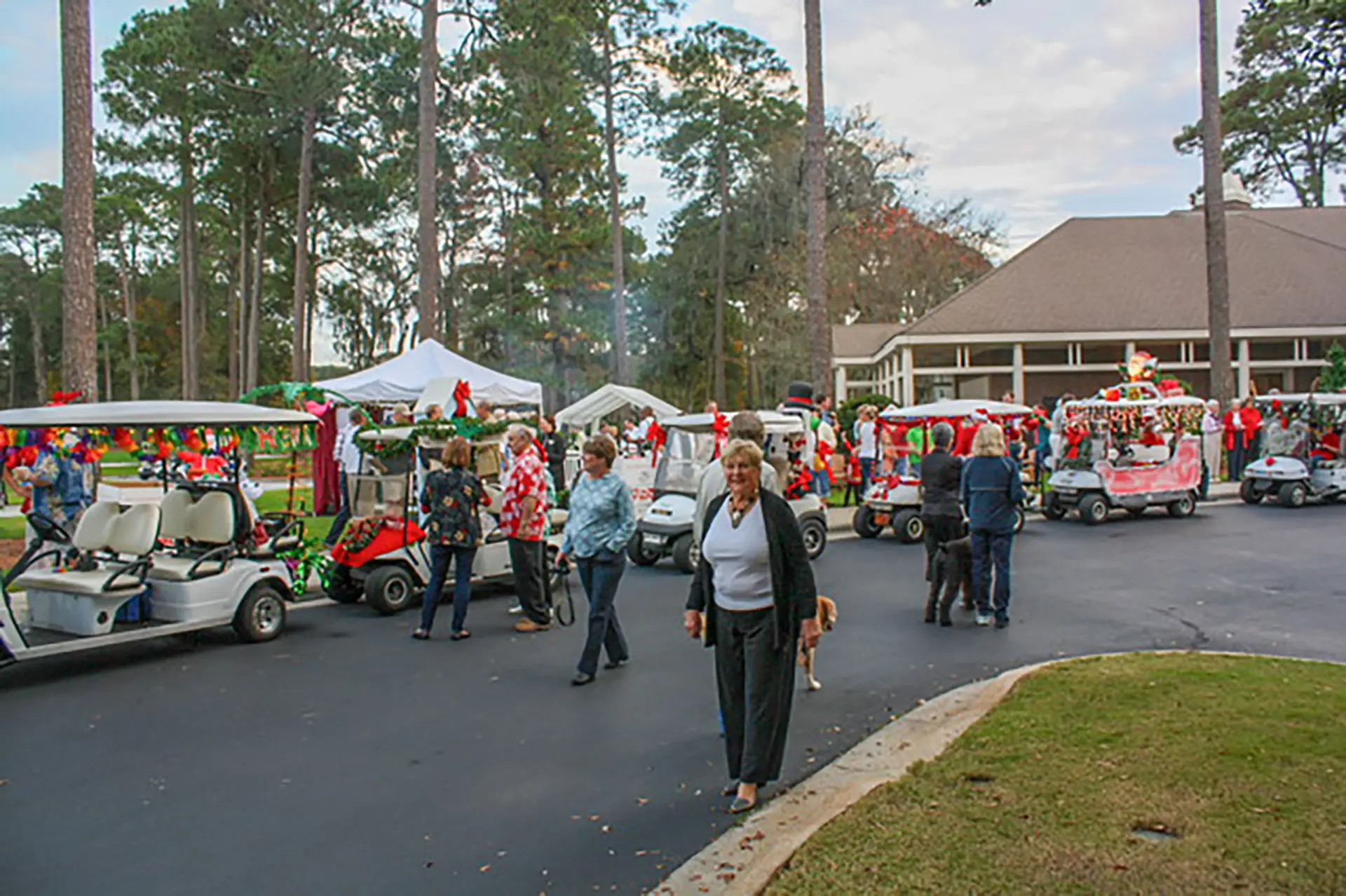
Let’s face it: golf carts are just a lot more exciting to drive around the neighborhood than a car because of the freedom and social aspects of cruising in an open-air vehicle. And especially around the holidays. At The Landings, hundreds of residents deck out their carts for Halloween and go trick-or-treating. Parades on Memorial Day and Christmas are also a big deal, as is getting to the Fourth of July fireworks show or the giant New Year’s Eve party. The community even has its own dealership and repair shop with new and used models from Club Car, E-Z-GO, Yamaha, Atlas, Denago, Star, and Dach. (Other up-and-coming brands include Evolution, Bintelli, and Tomberlin.)
The shift from fairways to roadways has manufacturers retooling, clubs reconsidering policies, and towns revising ordinances—sometimes enthusiastically, sometimes with a hard “not on our streets.”
“We saw the appetite rocket-ship after Covid,” says Adam Harris, vice president and general manager at E-Z-GO. “People couldn’t travel, but they wanted freedom and fresh air. The consumer market exploded—and so did innovation.”
E-Z-GO’s journey mirrors the category’s arc. Founded in 1954 by two brothers fresh out of the service, the company grew from a one-room machine shop in downtown Augusta, Ga., into a 1,000-person campus that designs and builds tens of thousands of vehicles a year.
“Augusta is our hometown,” says Brandon Haddock, the company’s director of communications. “Every E-Z-GO you see shipped around the world is built here.”
The inspiration, fittingly, was a Masters moment. As the story goes, the Dolan brothers spotted an early three-wheeled Autoette at Augusta National and thought, “We can build those.” They weren’t first to market, Haddock says, but they cracked the code that mattered: mass production at a price that turned carts from curiosities into full fleets. What courses once bought in ones and twos became 50-car lineups—consistent, durable, and financially sensible.
The introduction of fleets revolutionized the game in many ways, from allowing people who are less physically mobile to play to stretching out routings to allow for homes and more daring designs, such as mountain courses. Today, the fleet business remains a pillar for the major brands. But the growth is coming from individual owners. As The Wall Street Journal reported last summer, the U.S. market for on-road carts has ballooned to an estimated $5 billion from roughly $1 billion pre-pandemic. The PTV boom has reframed how the industry designs.
“Historically, we built for course operators first,” Harris says. “Now we’re following automotive trends. A personal vehicle should feel automotive.”
At E-Z-GO, that means safety-forward braking, lithium power, and forward-facing seating for families. The company’s RXV platform, freshly restyled for model year 2026, can be outfitted with integrated LED lighting, Samsung SDI Elite lithium batteries, and “Intellibrake,” a patented system that replaces the old latch-and-hope parking brake with car-like confidence at a stop. A new 10-inch infotainment-screen option brings Android Auto and Apple CarPlay, plus a personal-passcode lock and adjustable speed profiles—handy when a licensed teen is at the wheel.
Then there’s the Liberty, launched in 2021: four forward-facing seats on a slightly longer chassis, a seemingly simple tweak that solved an obvious problem. “People feel more secure looking ahead, especially with kids,” says Haddock. The layout also makes conversation easier—more family sedan than utility bench.
Yamaha’s take aims to meet every use case. “We have rugged UMAX Rally models for utility and a PTV that’s essentially a fleet car with turn signals and headlights,” says Sloan. “If your course allows personal carts, you can drive to the club with your bag in the well and go play. If not, park at the clubhouse and hop on the fleet car.
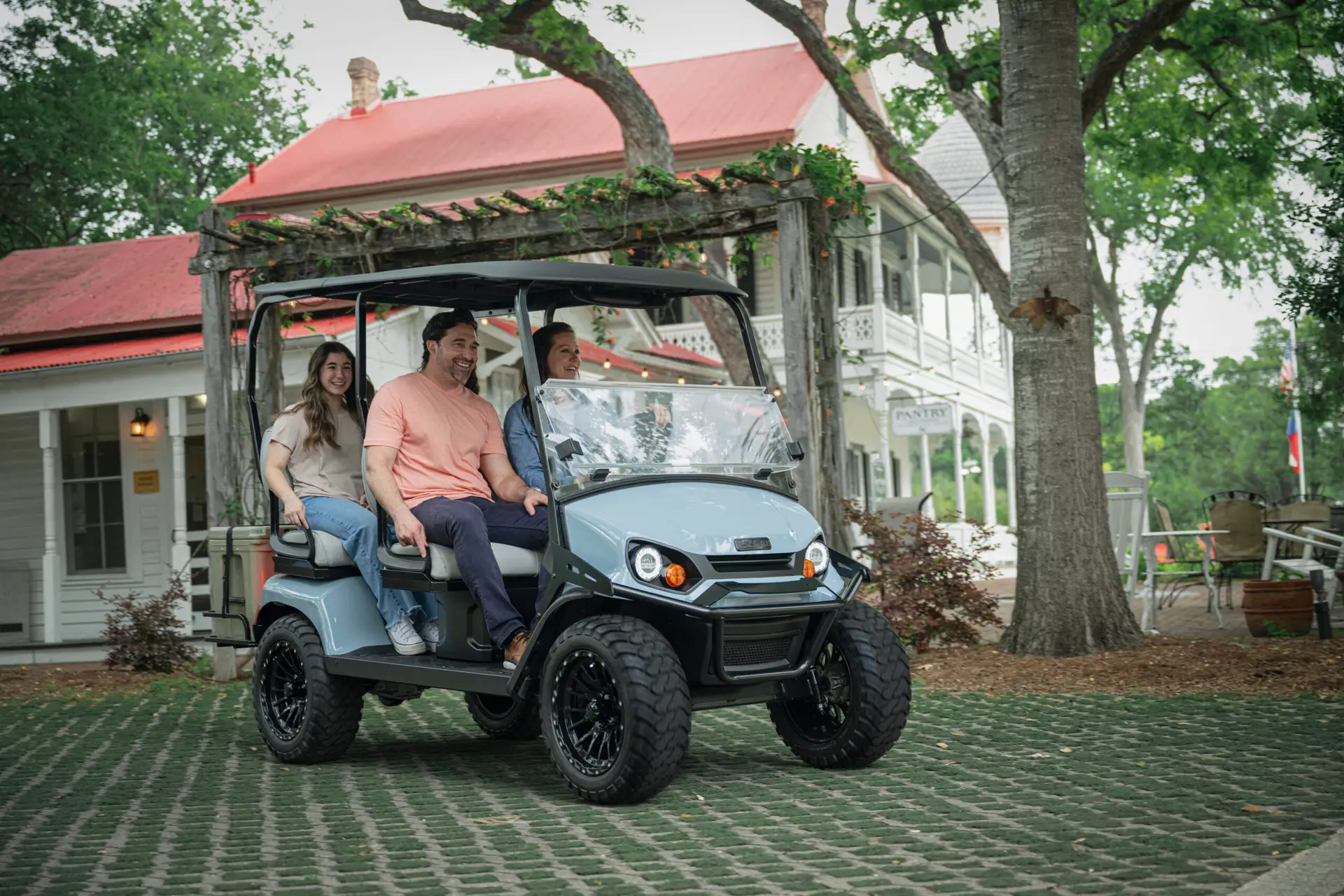
“We’re finding a lot of crossover between the fleet customer and the PTV customer,” Sloan explains. “Golf and personal transportation have direct correlations. The same people that are playing golf and have that expendable income are buying PTVs.”
That duality—one vehicle for the neighborhood, another for the course—reflects the reality that not every consumer cart belongs on turf. “A UMAX Rally with off-road tires would tear up a golf course,” Sloan notes. “But we offer PTVs that won’t.”
As personal carts multiply, courses have to maintain speed control and protect sensitive ground. That’s where fleet technology is quietly stitching the two realms together.
E-Z-GO’s Pace Technology—long a course-operator tool to monitor fleet cars—puts GPS mapping, geo-fencing, and messaging on cart screens to keep vehicles off greens and tees, manage pace of play, and enable food and beverage ordering. “For private owners whose clubs allow personal carts, we can add Pace so they see the same hole maps and restrictions,” says Peter Claus, vice president of Pace Technology. “The course doesn’t lose visibility; the owner doesn’t lose features.”
The next step, Claus says, is bringing Pace sensibilities home: “Geofencing a neighborhood boundary for your teen, seeing where the vehicle is in real time, setting speed limits—all the connectivity you expect from a modern car, scaled to open-air mobility.”
Also helping power the boom is the lithium battery, which is lighter, smaller, maintenance-free, and quicker to charge than legacy lead-acid packs. E-Z-GO was early to mass-produce lithium in golf cars, partnering with Samsung SDI on its Elite battery. Lithium batteries also mean most can recharge from a standard 110-volt GFCI outlet. For those seeking fewer cables, E-Z-GO’s partnership with WiTricity enables inductive pad charging: park over a pad and the vehicle tops up—no plug-in required.
The popularity of PTVs has brought celebration and resistance in equal measure, as The Wall Street Journal noted. Street-legal and street-permitted carts have surged since the pandemic, prompting municipalities to write or revise ordinances on the fly. In cart-friendly towns, critics complain about clogged traffic, underage drivers, and inattentive cruising; some municipalities have said “not yet,” citing safety at busy crossings and concerns about unsupervised teens.
That’s not a problem back at The Landings, with dedicated cart paths running literally everywhere. “There’s so much of the island you can see with a golf cart, watching sunsets down on the marshes, taking them to the marinas,” Lorfano says. “It’s one of those things you almost got to see it to feel it. People like being in their golf carts. It’s just the freedom of being in that cart and running around.”
REGULATIONS 101:
PTV vs. LSV (Know Your Letters)
Part of the confusion on the street is nomenclature. The industry and the government use overlapping terms:
PTV (Personal Transportation Vehicle): These are golf carts and golf-car derivatives built for neighborhood use with added features (headlights, taillights, horn; seat belts as an option). Typically capped below 20 mph and governed primarily by state and local rules, PTVs are not inherently “street legal” in the DMV sense, but many municipalities permit them on roads of 25 mph or below with a local permit.
LSV (Low-Speed Vehicle): A federally defined class overseen by NHTSA, these vehicles meet stricter equipment standards (e.g., three-point belts, lighting, reflectors, often VIN and plate) and are allowed on public roads signed 35 mph or less. Manufacturers typically set top speeds to 25 mph.
“The most important thing is to understand your local rules,” says E-Z-GO’s Brandon Haddock. “Your dealer will know whether you need seat belts, a high-mount strobe, or a permit—and whether your town treats a PTV like a cart or like a car.”
Yamaha’s Chase Sloan adds that communities and clubs often set aesthetic or size limits—wheel diameter, overall height, tread aggressiveness, even color—to protect turf and keep a consistent look.