Up close, Tom Kite was grinning like a kid on Christmas morning. From 10 feet away, however, you couldn’t make out his smile or even the top of his head. The World Golf Hall of Famer, who turned 76 on December 9, was nearing 75 on this day, a day I shared with him in a Wisconsin field, engulfed by native grasses taller than we were. Kite tromped, whirled, pointed, and noted. He was in his element. I was, too.
The occasion: The 2024 ASGCA Foundation Design Boot Camp. The setting: raw land adjacent to Erin Hills Golf Course, 35 miles northwest of Milwaukee, home to the 2017 U.S. Open and 2025 U.S. Women’s Open. The purpose: Pay a hefty tuition—the bulk of it tax-deductible—to benefit the ASGCA Foundation and its designated charities with an unprecedented immersion into the art and science of golf course design. The goal: To learn the concepts and details behind designing a course, in a classroom setting and on an undeveloped golf site, from an elite cadre of architects. The result: Previously, I thought I knew a little something about architecture. Hah! Boot Camp opened my eyes.
As an invited media observer, I was expected to observe. After a late cancellation, however, I was thrust neck-deep into the role of contributor. I had been advised to pack long pants/jeans, boots or study shoes, and rain gear, as we would literally be “in the field.” Beyond that, my slate was blank—soon filled to overflowing.
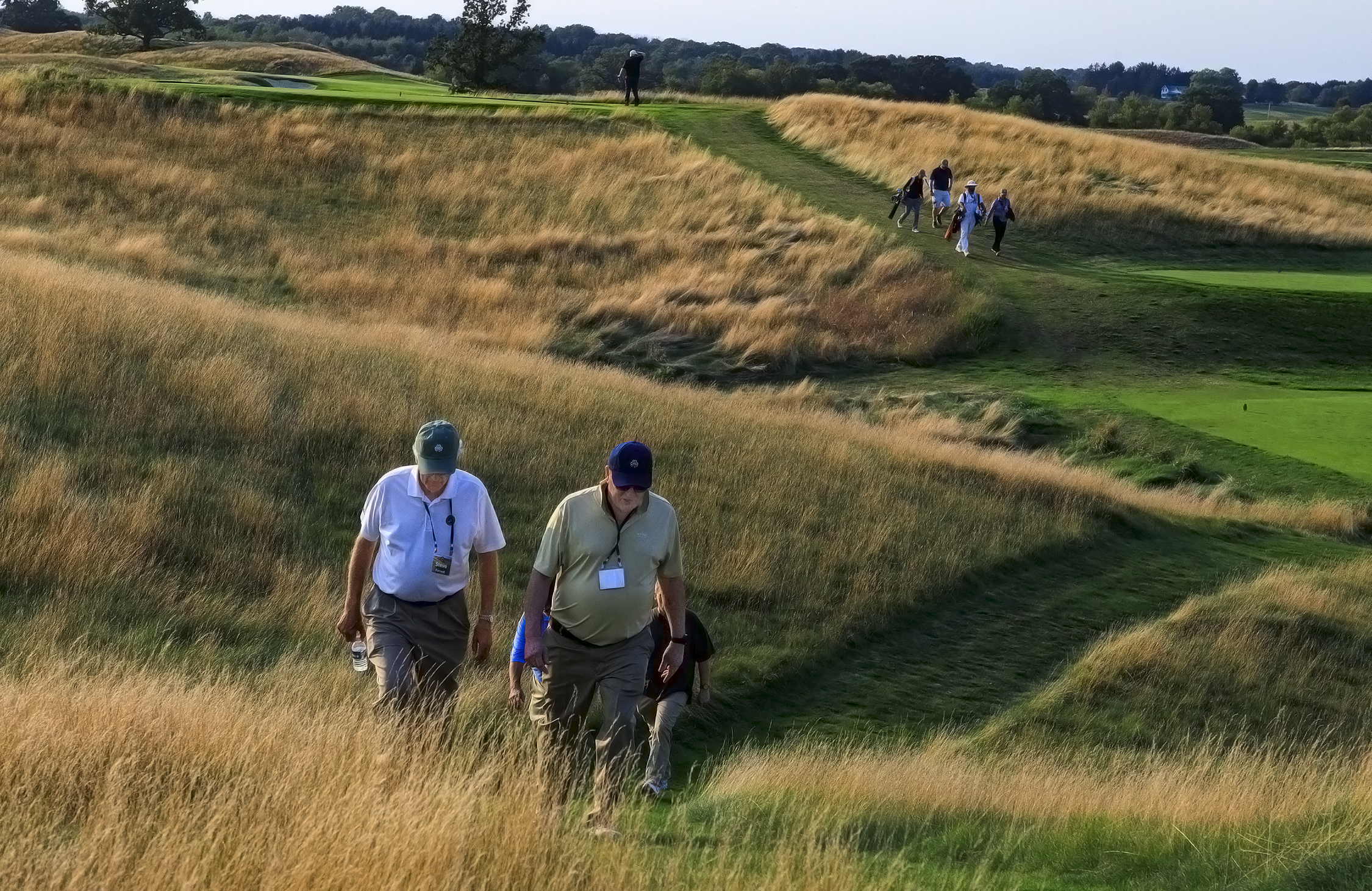
After arrival and check-in, the dozen or so attendees met our instructors: Dr. Michael Hurdzan, Jan Bel Jan, Steve Forrest, Bruce Charlton, Damian Pascuzzo, Tom Marzolf, and Jeff Brauer. Each had not only designed multiple top 100s/professional Tour venues but were also past presidents of the American Society of Golf Course Architects. And they were here on their own nickels. Respect.
Classroom sessions kicked off the proceedings. Bel Jan led with “Evolutions in Golf Course Design Philosophy and Strategy”—well within my comfort zone. Forrest followed with “An Introduction to Golf Course Routing Principles.” OK, I had a nodding acquaintance with this topic as well. Pascuzzo continued with “Formal Design Phases, Site Evaluation and Design Guidelines.” I knew from years ago that Pascuzzo crafts small batches of marvelous homemade limoncello. What he was serving up today was a little tougher to swallow. That was only the beginning.
Attention now turned to pairing students with instructors. My team consisted of Tom Kite, who paid to enroll in this unique class, and me. One U.S. Open champ and a guy who watched him win it at Pebble Beach as credentialed media. One guy who actually had design experience, working with Bob Cupp, Randy Russell, Roy Bechtel, and Billy Fuller, among others. Two of his co-designs had hosted PGA Tour events. The other guy? He had written about design for 30 years without ever moving a teaspoon of dirt. This would be interesting.
Fortunately, Pascuzzo and Brauer—two men I had known for years—were to be our tutors. Unfortunately, neither man was going to let me defer everything to Kite. They insisted I join them for every part of the journey. What a ride it turned out to be.

Following a quick look at the parcel our team was given from which we would create our design, Dr. Hurdzan regaled us with a brief history of how the Erin Hills course he co-designed came to be. Erin Hills would provide the ideal palette for this exercise, with plenty of compelling available acreage next door to the championship course and superb facilities. Once dinner concluded, we retreated to the Drumlin Putting Course, illuminated at night for laughs and learning.
Day 2 proved to be the most engrossing, head-spinning educational experience I had enjoyed/endured since law school. It began with a “Reading Topo Maps” presentation from Brauer and Pascuzzo. I’m not a camper, hiker, city planner, or golf course architect; the challenge of this task proved formidable. Fortunately, our teachers were patient, if persistent, and Kite was a whiz. Out we went to our parcels.
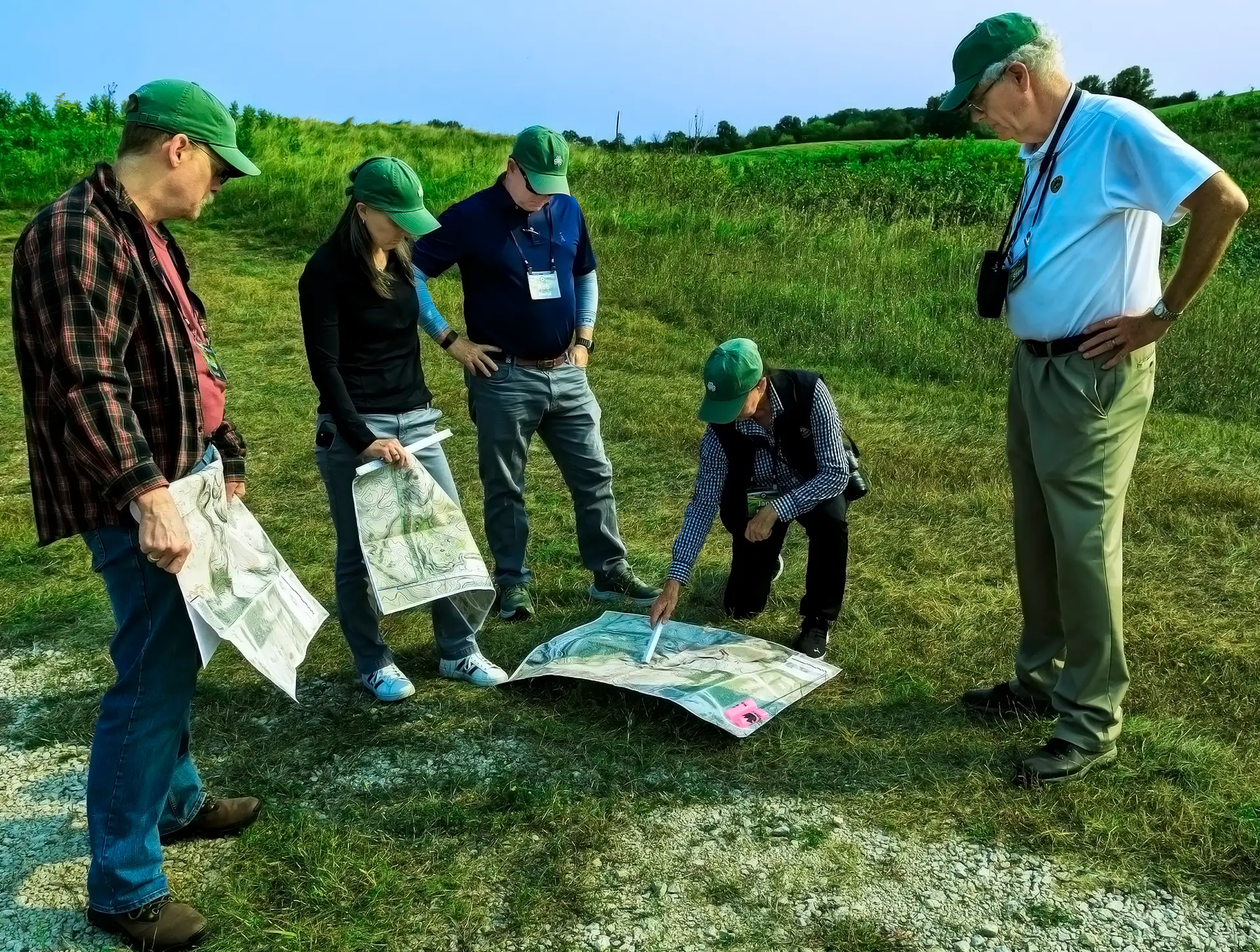
A-ha! This is where my vast experience walking golf courses in every stage of construction would benefit. As coach Lee Corso would say, “not so fast, my friend.” We had a cool site to route four or five holes, including elevation change, a wetland, a few prominent trees—all the necessities for potentially good golf holes.
But how to maximize this parcel to get the best use from the terrain and natural attributes? There were limitations. An entrance road here. A parking lot there. Play around or over the wetland—or not? How to make the puzzle pieces fit? We pounded in stakes, consulted the topo maps, weighed the contouring and distances. This was compelling—but hard!
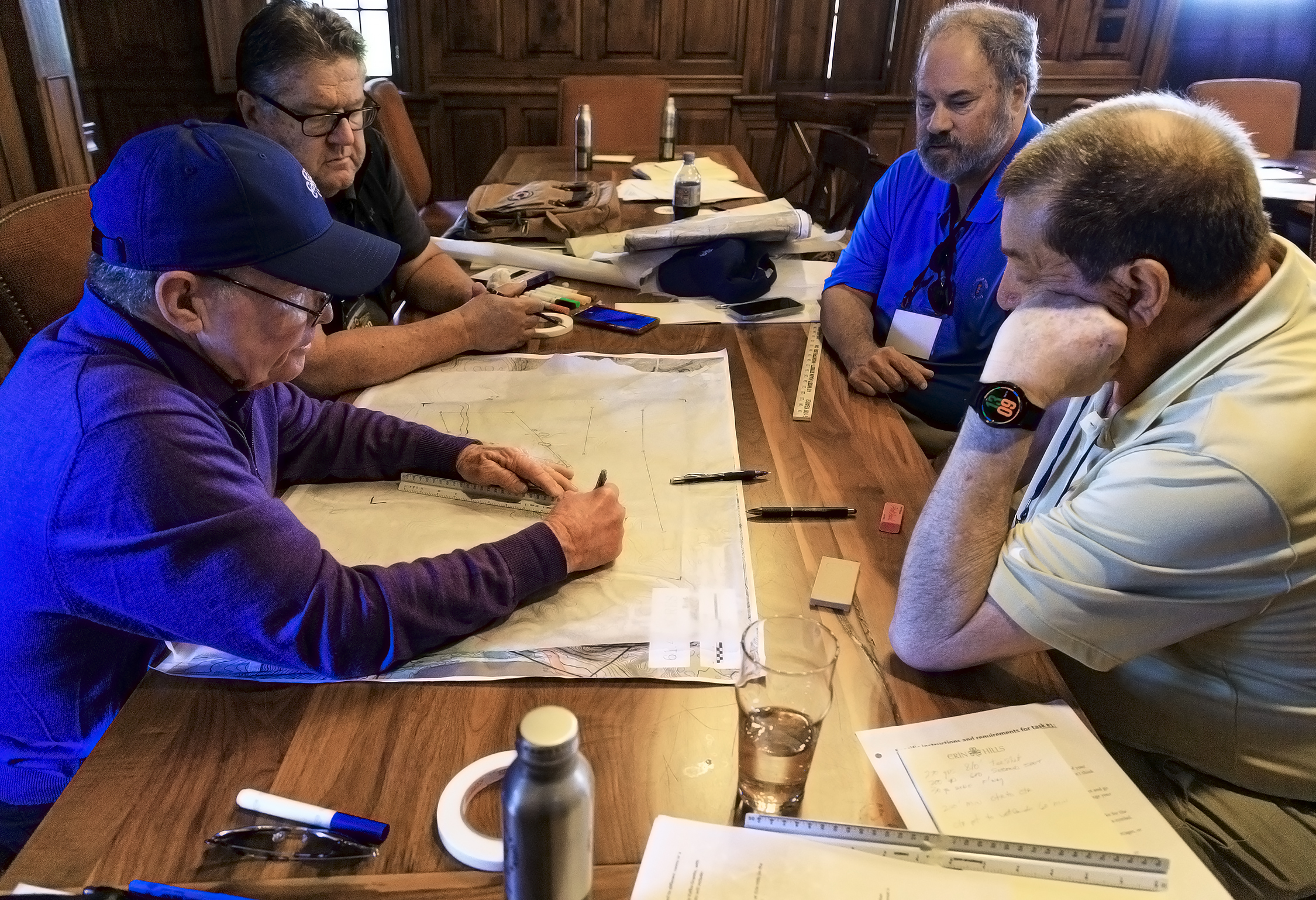
Eventually, we reassembled in the conference room, took to our colored pens and created art, if not architecture. The architecture would come after more knowledge-infusing lectures. I relished Charlton’s “Design Development and Basic Criteria for Hazards and Hole Strategy.” Then the headbanging resumed with Marzolf’s “Construction Documents (grading and drainage).” It was nearly impossible for me to process the minutiae, the staggering number of details, that accompanies every aspect of completing a golf hole.
In the late afternoon, groups assembled to play the Kettle Loop, a modified five-hole stretch on Erin Hills that would stimulate us to pick out details and ask questions: What features were natural, and which were created—and why did the architects do what they did? Paired with Kite in a two-ball at the par-four-and-a-half first hole yielded a supreme “These guys are good” moment. Only a week before, I had been re-reading something Johnny Miller had opined two decades earlier.
“I would have been much more fearful of Kite had he laid up,” Miller wrote, “because he was (and still is) one of the best wedge players in the world and could have holed his third shot for eagle.”
Right on cue, Kite holed his third shot from 93 yards with a wedge at Erin Hills’s opening hole. Show-off!
On Day 3, after an exercise that involved converting a design development into a grading plan—more aspirin, please—we took in Brauer’s “Guidelines for Green Design” presentation. I was officially baked—and loved it.
For folks who could still focus, the reward was a trip around all 18 holes at Erin Hills, followed by a final dinner and a session in the pub where the architects told war stories about life in the profession. Our brains bulging with new-found know-how, this was the cool-down. Passionate, successful practitioners talking turkey about the subject we cherish.
The one-of-a-kind Boot Camp experiment proved so successful, the ASGCA has made it two-of-a-kind. In March 2026, the event will be reprised at Pinehurst Resort in the Sandhills of North Carolina. Participants will plunge into course design with nine ASGCA past presidents, study and route a layout on the Pinehurst Sandmines property, and topping the sundae is a pull-back-the-curtains tour with Bill Coore on the new Pinehurst No. 11 course he is designing with partner Ben Crenshaw.
For an architecture buff, ASGCA Foundation Design Boot Camp is the equivalent of a guy or gal with a sweet tooth drowning in a chocolate waterfall. It is intense and intensive yet hugely gratifying. Wisely, organizers have extended the four-day session to five days, making the immersion less of a whirlwind. If you have the means to support a great cause, and the desire to wave that design wand via indoor and outdoor education (and ultimately create golf holes on a legendary canvas), the ASGCA’s Design Boot Camp at Pinehurst is the experience of a lifetime.
To sign up or learn more, go to https://asgcafoundation.org/architects-boot-camp-2026