

They say that everything is bigger in Texas, but when it comes to massively scaled golf resorts, Florida takes top prize. A Florida golf feast includes not only a five-star main course, but side dishes—additional golf courses—that embrace both quality and quantity. In ranking these banquets of golf, the measuring stick is a property that has a buffet full of tasty offerings that are also loaded with variety.
Here are the top 10—well, 11—Florida mega-resorts of 45 holes or more.
Streamsong Resort, Bowling Green
Golf menu: Red (2012); Blue (2012); Black (2017); The Chain (2024)
Main course: Red
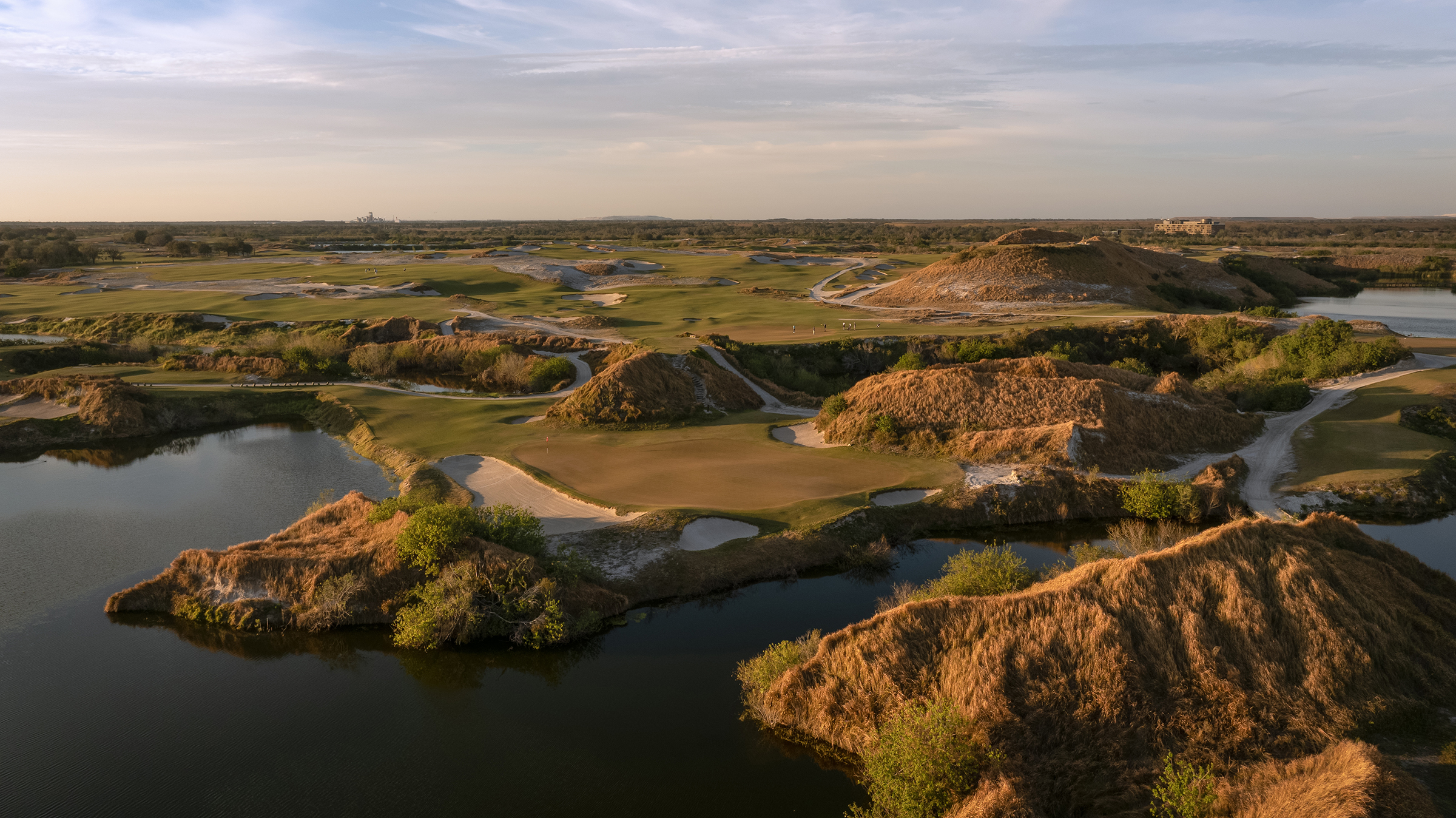
Frankly, Red, Blue, and Black are all main courses. Although the Gil Hanse-designed Black ranks behind Bill Coore and Ben Crenshaw’s Red and Tom Doak’s Blue, one leading industry publication lists it as the fourth best public course in Florida. That is serious depth. All were hewn from gigantic sand sprawls that evolved from a previous existence as a phosphate strip mine in rural central Florida, near Lakeland. The listed side dish is The Chain, a 19-hole short course crafted by Coore & Crenshaw. The flexible layout has options for six- and 13-hole loops with holes that vary from 50 to 300 yards. A 2.6-acre putting course called “The Bucket” completes the offerings.
Sawgrass Marriott Golf Resort & Spa, Ponte Vedra Beach
Golf menu: TPC Sawgrass, PLAYERS Stadium (1980); Marsh Landing (1986); TPC Sawgrass, Dye’s Valley (1987); The Yards (2020)
Main course: TPC Sawgrass (PLAYERS Stadium)
If there were such a thing as sibling envy among golf courses, Dye’s Valley would be a jealous monster, as it always takes a back seat to its older brother, the PLAYERS Stadium. Nevertheless, this 1987 Pete Dye/Bobby Weed design could hold its own almost anywhere else. Full of one excellent, hazard-strewn hole after the next, it somehow has few forced carries, with water often to the sides, which means less drama, more playability.
The prettiest and most natural of the Sawgrass courses is Marsh Landing, a private Arnold Palmer and Ed Seay creation within the community that offers limited access to hotel guests. Picture a golf course inside a nature preserve and you get the idea. For maximum family fun, Sawgrass aces that test with The Yards. Borne from the no-longer-existing Oak Bridge course, The Yards features 12 holes that can play to a par 44, at 3,695 yards. Mostly it’s used as two courses, a regulation nine called the Front Yard and a three-hole loop of par threes called the Backyard—often known as the Beer Loop by locals.
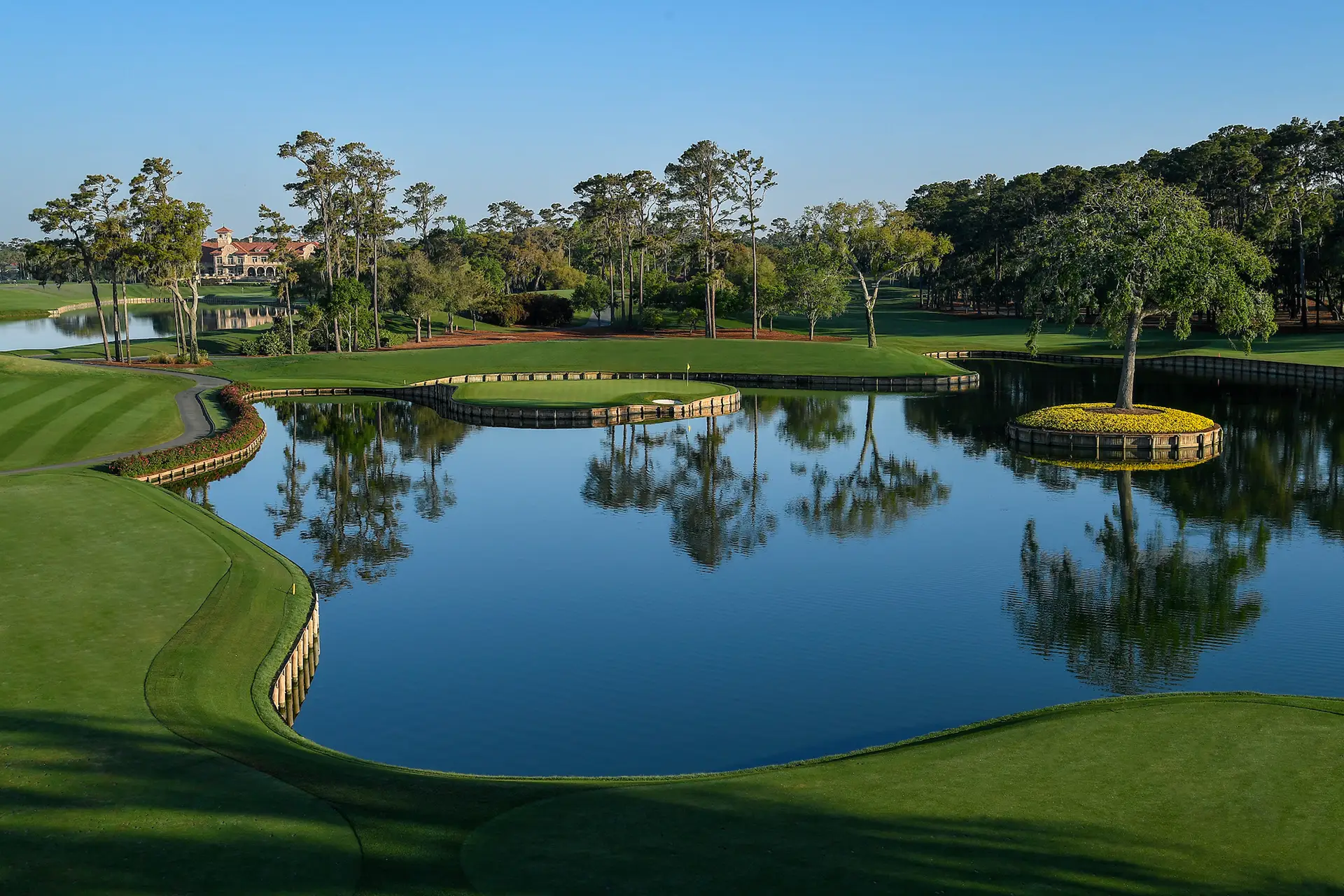
Nonetheless, you simply have to order the house specialty at least once. In 1980—and specifically at the 1982 Players Championship—TPC Sawgrass catapulted architecture onto the front page. It was all due to Pete Dye’s unparalleled mix of target and strategic golf, as well as trouble on every hole in the form of pot bunkers, waste bunkers, grass bunkers, small and severely undulating greens, stadium-like spectator mounds, and water everywhere, notably at the island green 17th. It precipitated copycat designs for nearly three decades.
Cabot Citrus Farms, Brooksville
Golf menu: Karoo (2024); Roost (2025); The Squeeze (2024); The Wedge (2024)
Main course: Karoo
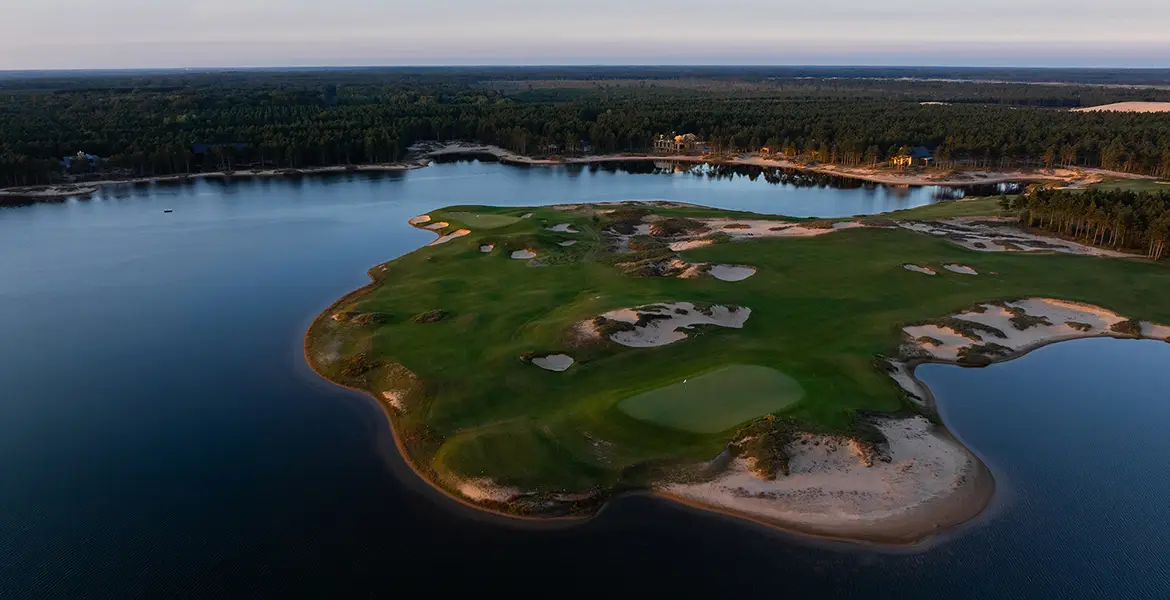
The jury is still out on Roost’s place among the nation’s top public courses as the layout only opened in January. For now, the nod goes to Karoo, a 7,562-yard Kyle Franz creation that pushed the envelope to the limit on bold shaping and bunkering and chaotically contoured greens. Roost, a collaborative design from architects Franz, Mike Nuzzo, and Rod Whitman, with input from several consultants, is tamer than its elder sibling, yet still wows with elevation changes up to 50. Don’t sleep on the two shorter courses; The Squeeze, a 10-hole spread from Nuzzo with holes that range from 100 to 550 yards, and The Wedge, another Nuzzo effort that features 11 holes lit for night play, plus contours and sandscapes that are definitely not dumbed down.

PGA National Resort, Palm Beach Gardens
Golf menu: The Champion (1981); The Palmer (1984); The Fazio (1980); The Estate (1984); The Match (2021); The Staple (2021)
Main course: The Champion
Clearly, nothing at PGA National can touch The Champion for challenge and tournament lore. The layout was originally designed by George and Tom Fazio and was a strong enough test to host the 1983 Ryder Cup and 1987 PGA Championship, but it didn’t come into its own until 1990, when Jack Nicklaus did a substantial renovation, including creating the infamous “Bear Trap,” the watery trio of holes 15, 16, and 17. The Champion also held the Senior PGA Championship from 1982–2000 and has hosted the PGA Tour every March since 2007.
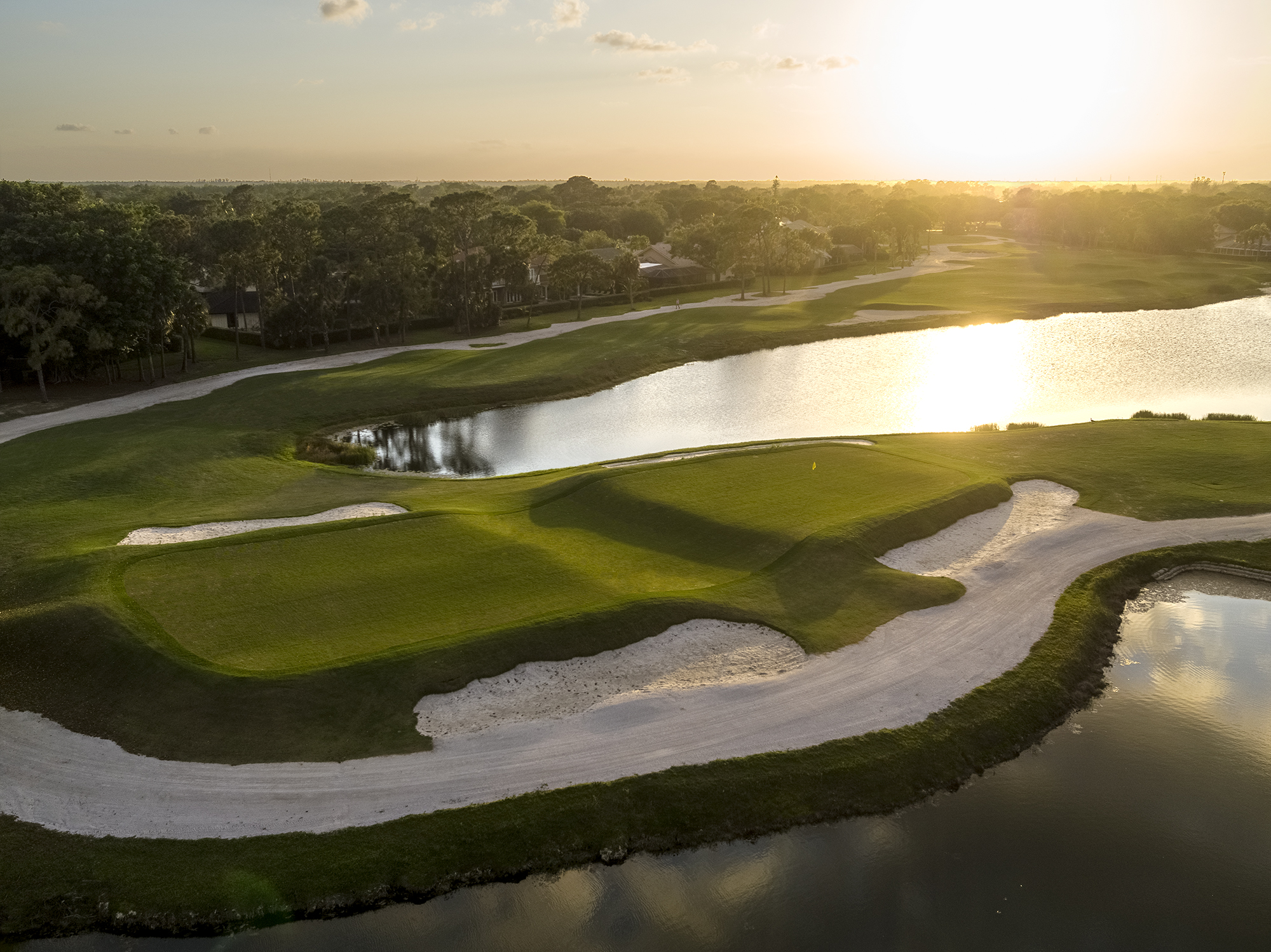
The Palmer, Fazio, and Estate courses are solid Florida golf; engaging, if not hauntingly memorable. PGA National catapulted to another level in 2021, after they engaged Andy Staples to scrap the old Squire course and create two funfests, The Match and The Staple. Designed for match play, 5,841-yard Match strikes with low-cut turf, minimal penalty areas, and no formal tee markers. The 9-hole Staple course offers holes from 48 to 130 yards—a quick, enjoyable romp.
Trump National Doral, Miami
Golf menu: Blue Monster (1961); Red Tiger (1962); Golden Palm (1969); Silver Fox (1984)
Main course: Blue Monster
Doral’s sides have rotated dramatically over the years. The 9-hole par-3 Green course debuted in 1962 but vanished in 2000 when the land was appropriated for use in Greg Norman’s new Great White course—which itself disappeared in 2015.
What’s left is pretty strong, notably the Golden Palm. Originally a Robert Von Hagge design, it was considered so demanding, its nickname was the “Gold Bachelor,” because so few women chose to play it. After several redesigns softened the layout, it was tweaked significantly by Gil Hanse when he reworked the Blue Monster in 2013. Today, Golden Palm sports Australian Sandbelt accents and ranks among the top 30 of courses you can play in Florida.
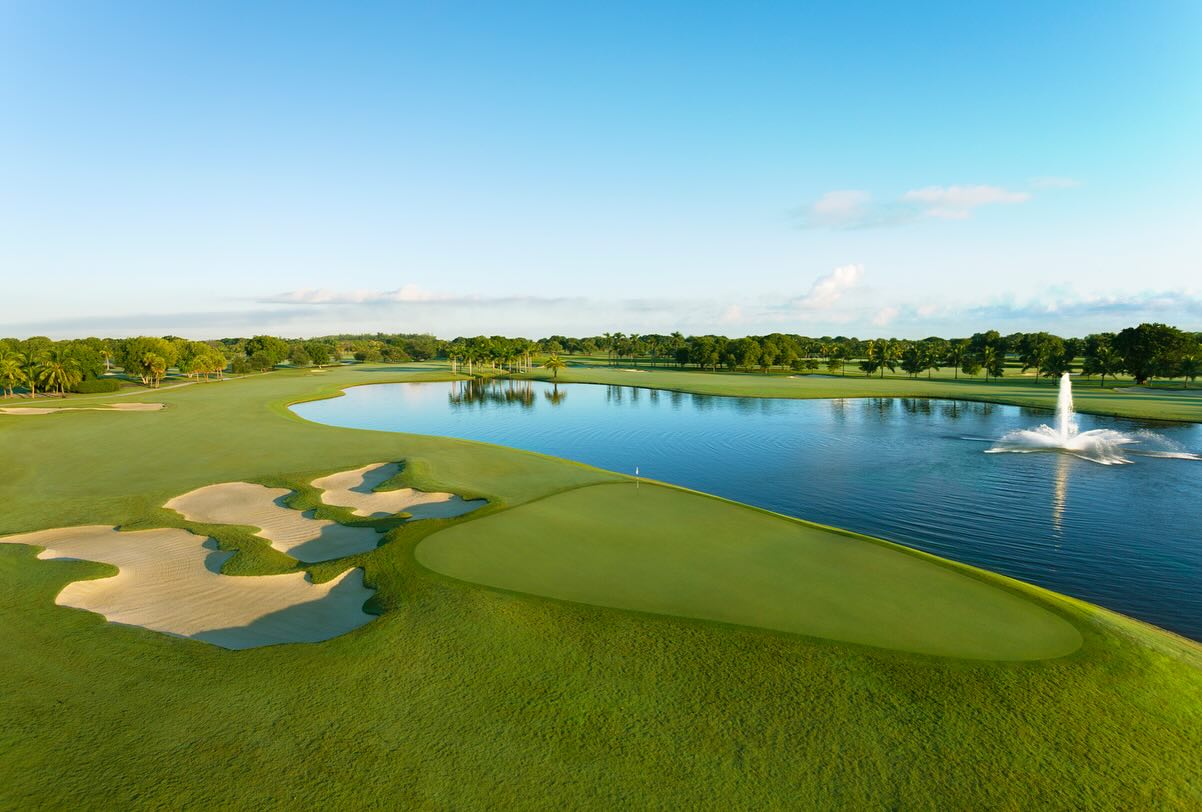
Hanse also made over the original Red, providing it with an intimate, northeastern feel. PGA Tour fans welcome back the Blue Monster for the Miami Championship in 2026, where it resumes its unmatched legacy, with tournaments winners that include Jack Nicklaus, Lee Trevino, Tiger Woods, and Ernie Els.
Innisbrook Resort, Palm Harbor
Golf menu: Island (1970); North (1972); South (1972); Copperhead (1974)
Main course: Copperhead
It’s hard to top Copperhead, designed in the early 1970s by Edward Lawrence “Larry” Packard and his son Roger. Home to the Valspar Championship since 2000, Copperhead was once called the best course the PGA Tour visits in Florida by Ernie Els. Its tall pines and significant elevation changes call to mind a Carolinas course. Thick rough, firm and elevated greens, water girdling landing zones, and a splatter pattern of deep bunkers make this one tough hombre.
But what a side dish the Island is! In 1990, it played host to the NCAA Men’s Division I Golf Championship, and the individual title that year went to Arizona State sophomore Phil Mickelson. At 7,194 yards, par 72, with a 75.5 rating and a 142 slope, it’s the virtual equal to Copperhead in difficulty. Lakes are in play on 10 holes and if the water doesn’t snare you, it’s likely one of the 74 bunkers will.
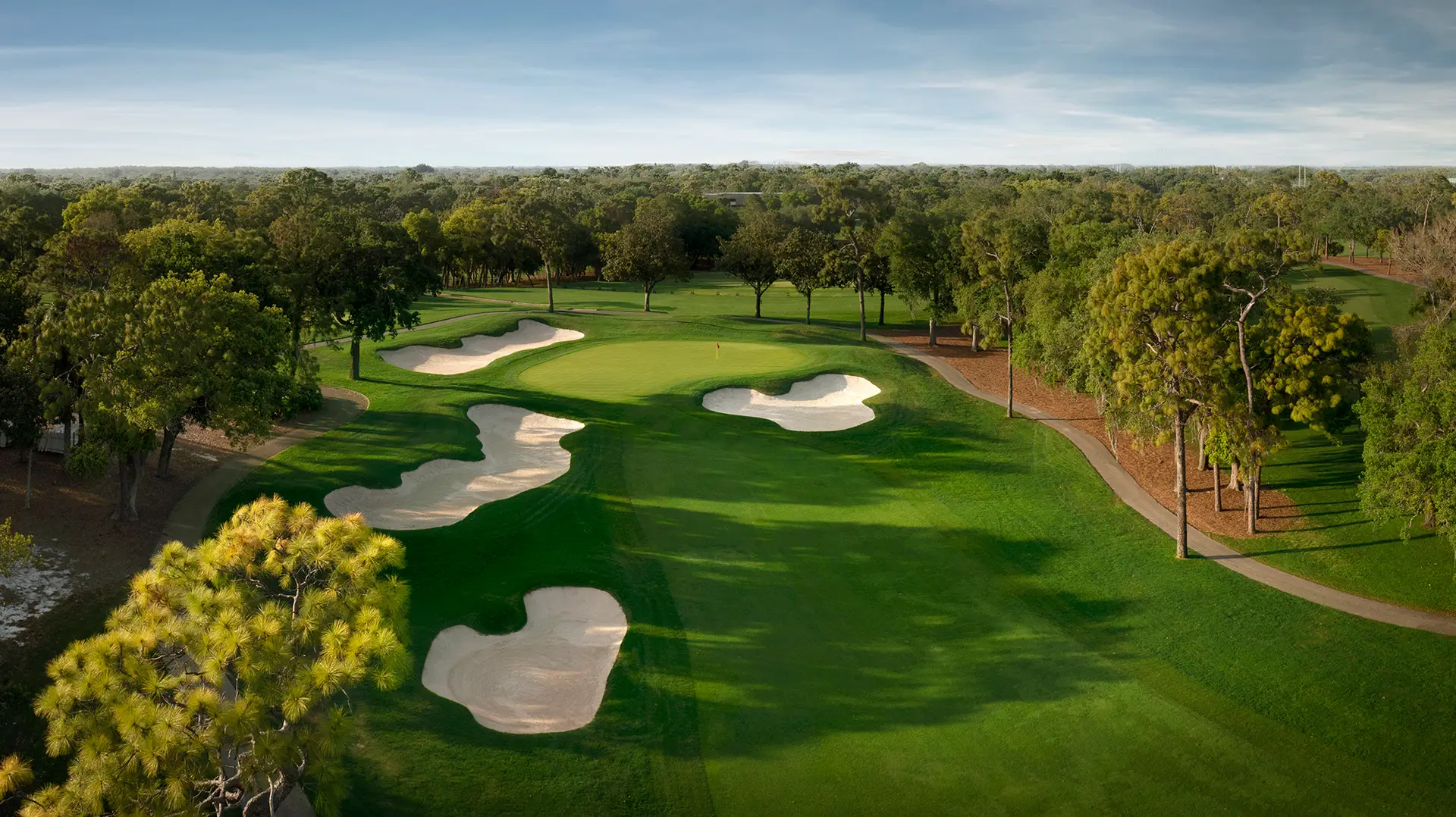
The 9-hole North and 18-hole South are holdovers from the 1972, Packard-designed 27-hole layout known as Sandpiper. Today, at 3,015 yards the North is an enjoyable stroll for golfers who want a little extra golf in a day, or who aren’t up to the rigors of Copperhead or Island. The South offers more of the same. North and South aren’t the reasons you journeyed to Innisbrook, but they offer variety and satisfaction for those who crave more golf.
Camp Creek Inn, Inlet Beach
Golf menu: Camp Creek (2001); Shark’s Tooth (2002); Origins (2007); The Third (2025)
Main course: Camp Creek
Camp Creek was northwest Florida’s top public course from 2001–06, went it went fully private. Guests of the on-site Camp Creek Inn have access to this Tom Fazio design, as do those who check in at the 11-suite Watersound Inn nearby. Camp Creek ranks among Florida’s top 50 thanks to challenges that include massive, undulating greens framed with generous if vexing runoff areas, numerous lakes, and wetlands and waste bunkers dotted with scrubby vegetation.
Aptly named Shark’s Tooth, this Greg Norman design ranks among the Sunshine State’s top 60. The layout eases in and out of tall pines with a mix of wide and narrow fairways in its 7,246-yard journey. A handful of forced carries spices the play, while fairways flow straight into the low-profile greens, encouraging creative low-to-the-ground approaches. Absent are rough, sharp edges, and mounding. Most memorable are back-nine stunners such as the 533-yard par-five 13th and the 213-yard par-three 14th that feature Lake Powell on the right side.
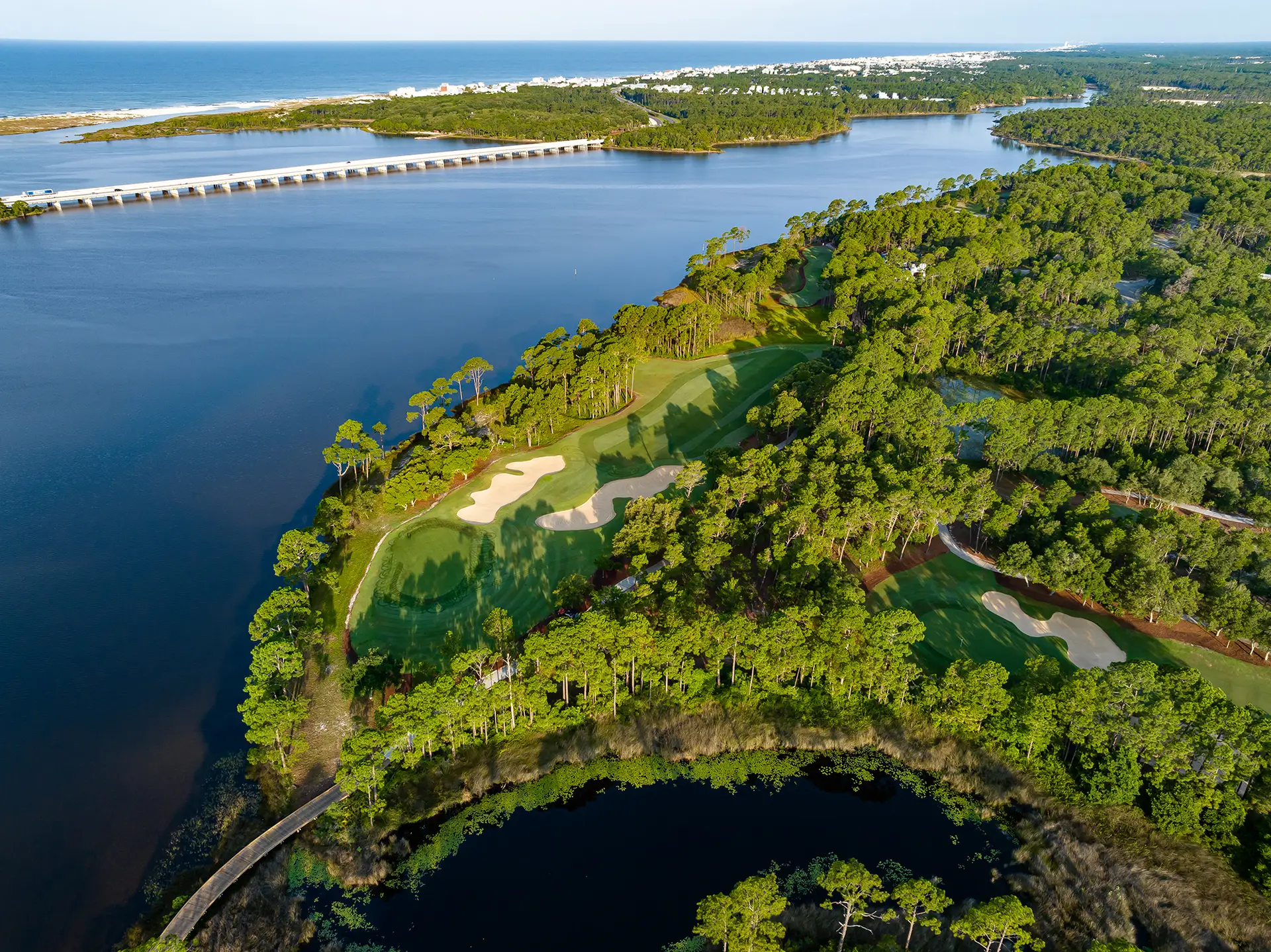
The 10-hole Origins course sits across the street from Camp Creek. Purely public, it’s 1,480 walker-friendly yards with minimal hazards designed by Davis Love III’s firm. Yardages range from 95 to 154 yards. A fistful of holes feature lakes, but they’re more decorative rather than penal.
Love’s latest creation opened in May 2025, called The Third. It’s a nice play on words—as the third championship layout for resort guests, as well as a nod to his own name—Davis Love III. Early returns are positive. Designed by Love, his brother Mark, and lead designer Scot Sherman, the 7,252-yard, par-71 spread is located just north of Shark’s Tooth and east of the Origins development. Large, boldly contoured greens complement the serene environment and playable tee-to-green journeys.
Omni Amelia Island Resort & Spa, Amelia Island
Golf menu: Oak Marsh (1972); Long Point (1987); Little Sandy (2022)
Main course: Long Point
An early effort from Pete Dye, circa 1972, appropriately named Oak Marsh reminded some of his work up the coast at Harbour Town. Oak Marsh is short, in the 6,500-yard range, and features tight fairways framed by moss-draped oaks, small and bulkheaded greens, the aforementioned marshes, and variety in the sizes and shapes of bunkers. In May, Oak Marsh reopened after a Beau Welling refresh. With all 18 greens rebuilt and new wall-to-wall turf and irrigation, playability, and conditioning are the best they’ve been in five decades.
Fazio’s Long Point remains one of Florida’s true hidden gems. Partly that’s because it’s a private club and doesn’t participate in resort packages. If you stay at the Omni, however, it’s accessible—and worth it, due in part to its back-to-nature setting and its back-to-back oceanfront par threes at holes 15 and 16.
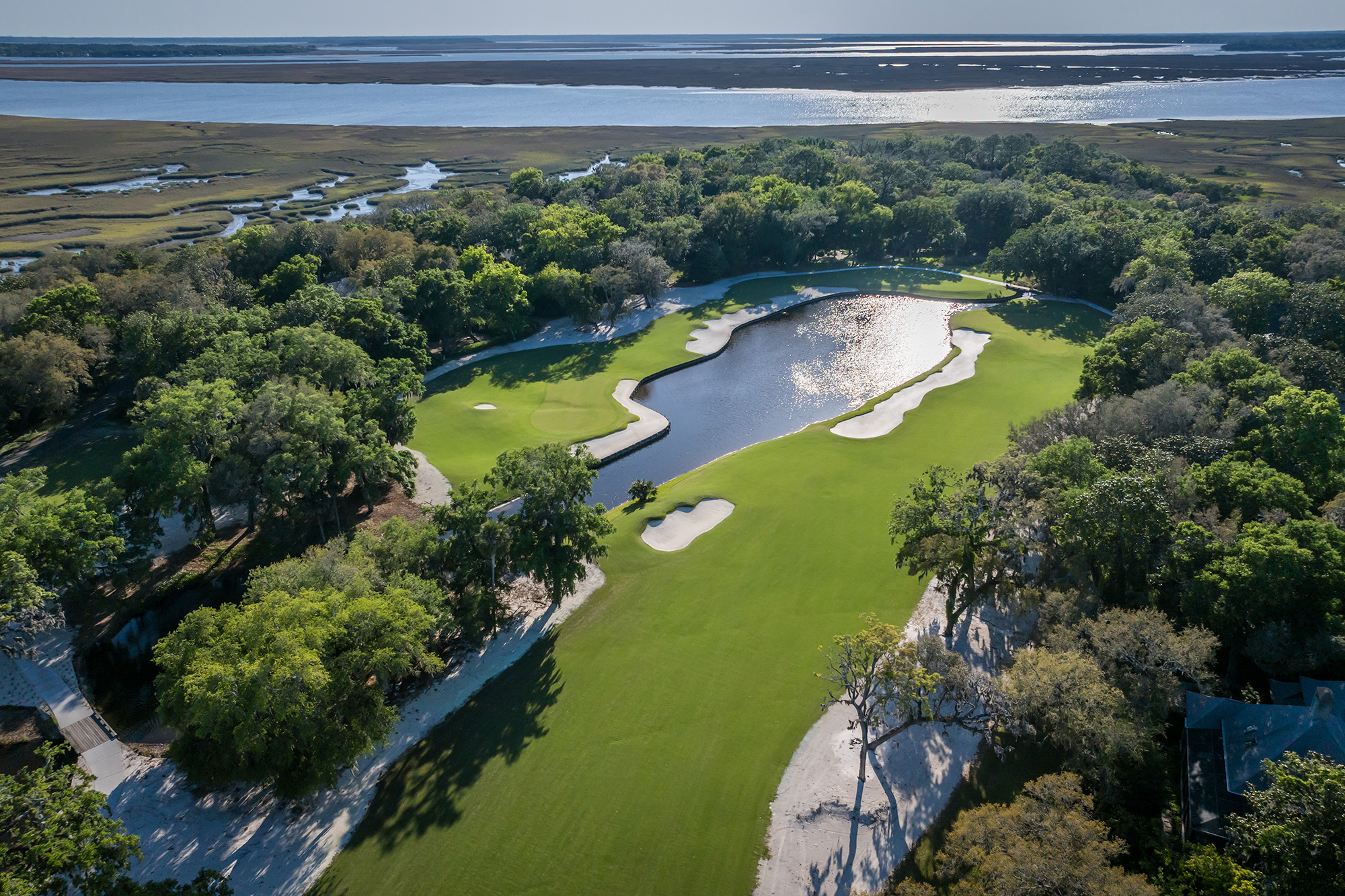
For those still misty-eyed about the closure of the Pete Dye/Bobby Weed Ocean Links in 2017, its replacement is the hugely popular Little Sandy, a 10-hole, walking-only short course by Beau Welling. Holes measure from 70–125 yards, with each sporting a boldly contoured green. Edging Red Maple Lake, Little Sandy delivers sandy native grass areas, dunes, and wildlife habitats.
Walt Disney World Resort, Lake Buena Vista
Golf menu: Magnolia (1971); Palm (1971); Lake Buena Vista (1972); Oak Trail (1982)
Main course: Magnolia
Joe Lee designed Disney’s three championship layouts, though each has been renovated by others over the past 15 years. Magnolia took center stage because it hosted the final round of PGA Tour events from 1971–2012. Jack Nicklaus and Tiger Woods are among those who triumphed on multiple occasions here. Flat, roomy fairways, lakes on 11 holes, 100 yawning bunkers, and thousands of magnolia trees provided instant character. Two long par fours to finish and the legendary greenside bunker in the shape of Mickey Mouse’s head at the par-three 6th were sufficient to cement Magnolia’s status as Disney’s must-play. Most recently in 2025, Magnolia witnessed holes 14 through 17 reimagined into “Grumpy’s Gauntlet,” that features vast waste areas of sand, reconfigured fairways, and wildly undulating greens.
Yet, historically, the Palm was always higher ranked. With nine water holes and narrower, more densely wooded fairways, the Palm provided a tougher test of driving than Magnolia and Golf Digest placed it among its Top 100 Greatest Courses in the U.S. from 1973–82. Not even the 2005 addition of 500 additional yards to Magnolia elevated it above the Palm. A 2013 renovation by Arnold Palmer’s design firm saw new greens and a new bunkering scheme. Palm served as co-host for most of the PGA Tour events held at Disney World.
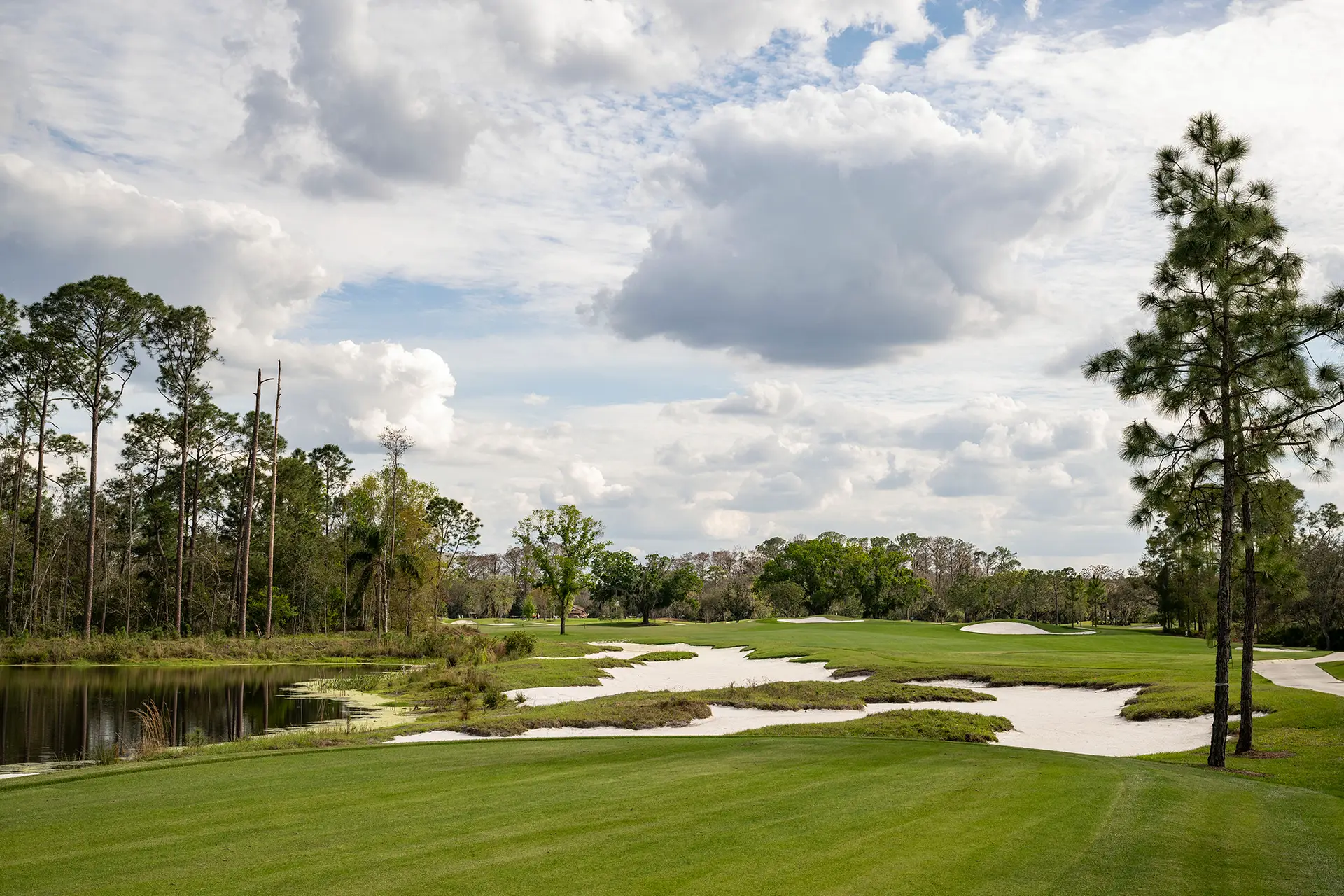
Lake Buena Vista was co-host to the PGA Tour events from 1982–97. LBV is shorter than Magnolia and Palm, with fewer hazards, smaller greens, and was built as a real estate play, but it’s absolutely testing enough to be worth a go-round. The 156-yard, island-green, par-three 7th, its diagonal green pinched with bunkers, is the photo-op here.
Oak Trail, a 9-hole, walking-only Ron Garl creation, is family friendly, yet offers a complete golf experience. At 2,801 yards, par-36, it’s hardly of championship length, but with two par fives, large bunkers, and a smattering of lakes, it’s got all the golf your brood could want, no matter what the skill level. And there are two sets of Junior tees, a par-40 for kids 12 and older and a par-52 for children 11 and under.
Sandestin Golf and Beach Resort, Destin
Golf menu: Links (1973); Baytowne (1985); Burnt Pine (1994); Raven (2000)
Main course: Burnt Pine
Sandestin hit a golf peak in 2006–07 when its newest course, the Raven, played host to the Boeing Senior Tour event, with Bobby Wadkins winning the first year and Loren Roberts the second. That layout, a 2000 Robert Trent Jones II design, is ideal for resort golf—wide fairways, huge, undulating greens, massive bunkers, and a healthy collection of lakes and wetlands. Burnt Pine barely slips by as the Main course—it’s $10 more to play there than Raven, hence the top spot. Rees Jones crafted Burnt Pine in 1994. It features smaller (though still good-sized) greens than Raven, more perimeter mounding, and more movement in the fairways. It also serves up three of the best holes on the property—the 13th, 14th, and 15th that offer stirring views of Choctawhatchee Bay.
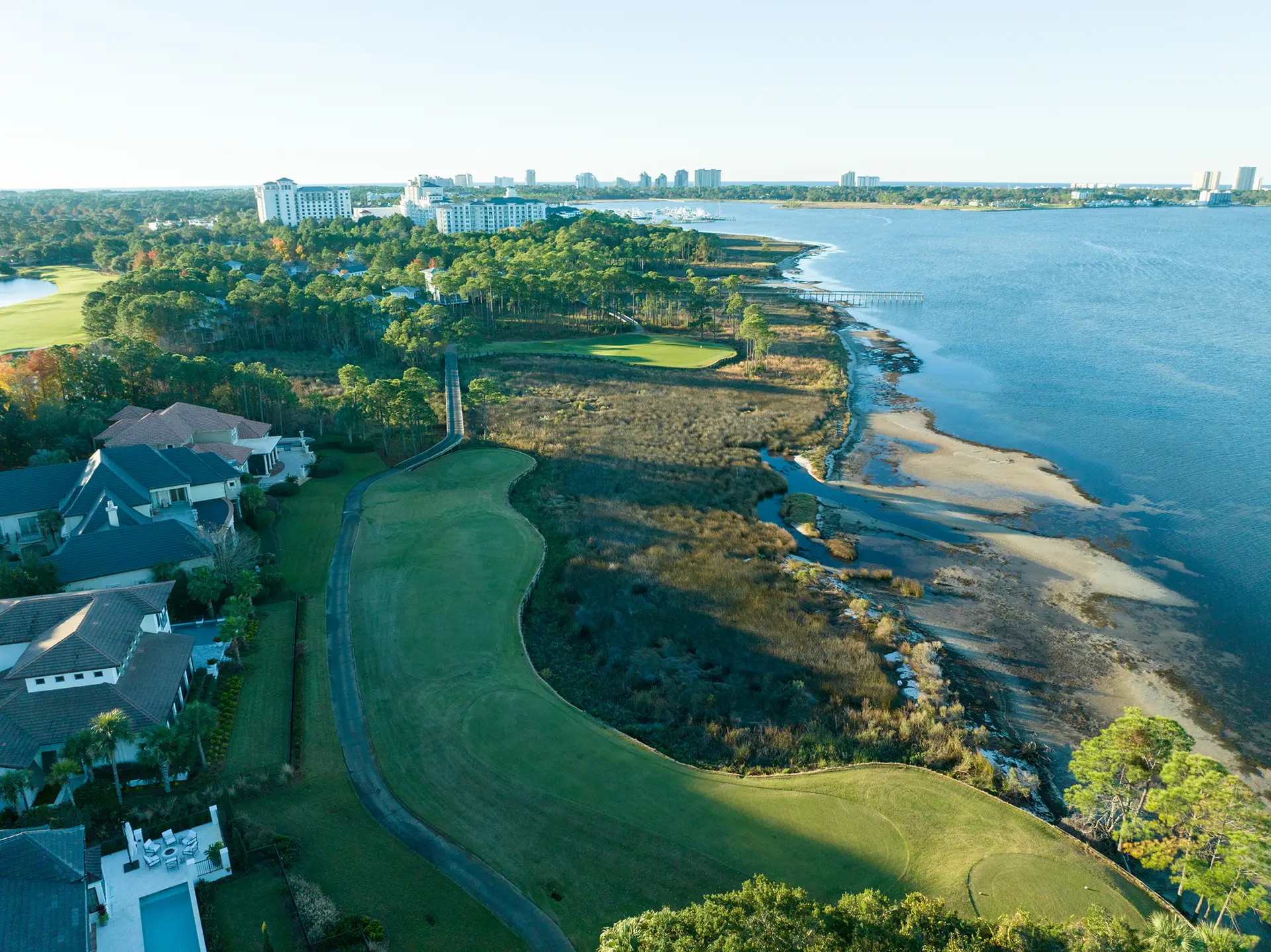
Regulars and locals who are nostalgic for the way golf in the region used to look 50 years ago will warm to the Links, Sandestin’s original course. With more exposure to the Choctawatchee Bay and Baytowne Marina, it’s the track most influenced by sea breezes. Combined with the slender landing areas and multiple lakes and wetlands, layups and prudent course management are required, frustrating the grip-it-and-bomb-it crowd, but making for a pleasant day for nearly everybody else.
In its beach-to-bay journey, Baytowne actually delivers what passes for elevation change in coastal northwest Florida, memorably at the downhill par-three 14th, with water left and back and bunkers just about everywhere else. If you’ve got the wee ones along, Baytowne provides set of tees just for them, at 3.002 yards.
Reunion Resort, Kissimmee
Golf menu: Palmer (2004); Watson (2004); Nicklaus (2006)
Main course: Watson
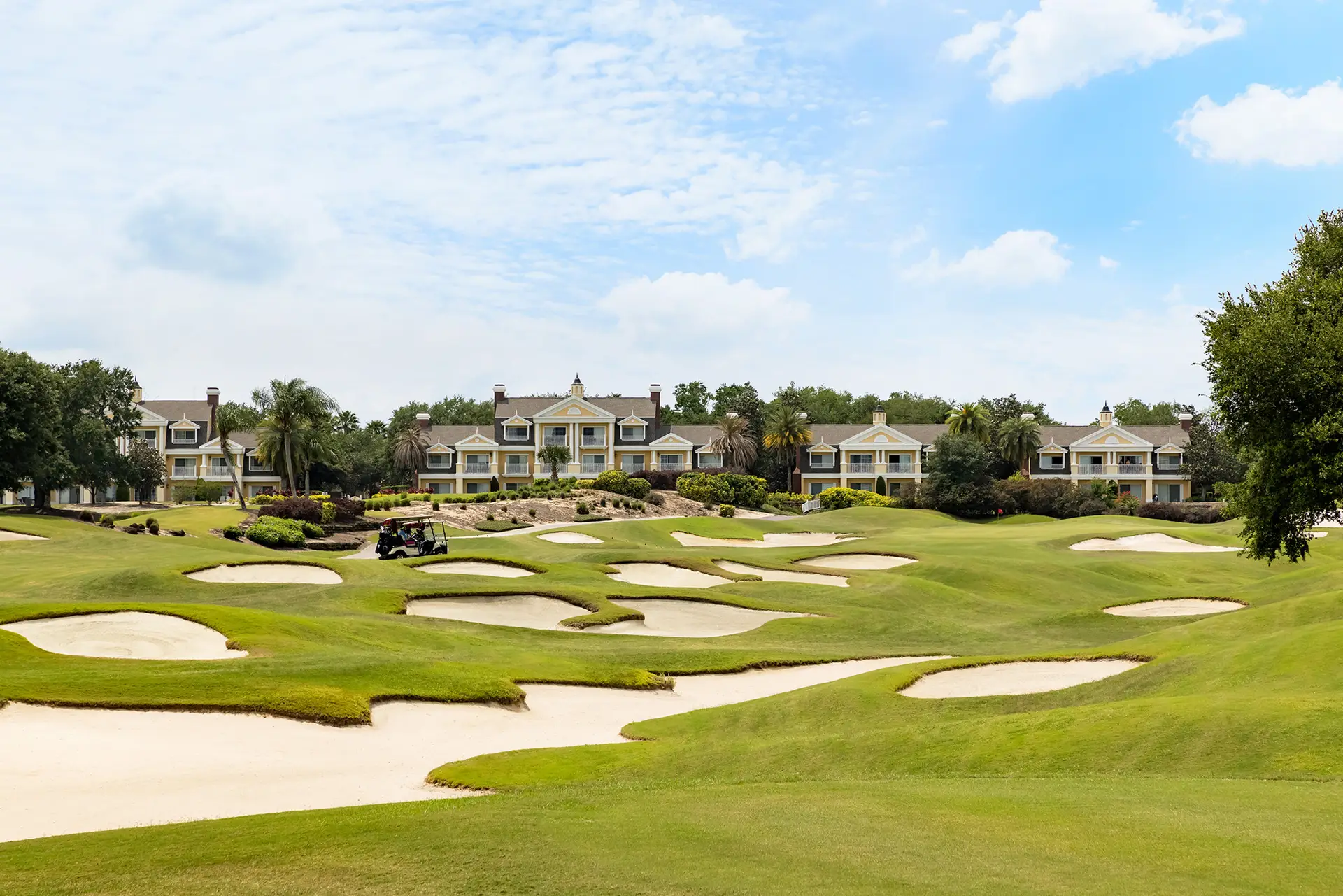
Of the three championship layouts at Reunion, it would take a series of coin flips and grill room debates to elevate one. Still, the safe pick is the course Tom Watson designed that was once known as the Independence. It’s certainly the most distinctive, a wildly undulating faux links that’s liberally sprinkled with mounds, bunkers and greenside chipping areas. Arnold Palmer’s layout—a.k.a. the Legacy—and the one Jack Nicklaus designed (the Tradition) offer more traditional Florida efforts, with roomy fairways accented by lakes and flowers.
Unquestionably, the Nicklaus is the toughest test, amid numerous forced carries and propped up greens. The LPGA Tour ventured to Reunion from 2006–08, and the composite course they played melded the front nine of the Palmer with the front nine of the Watson. Hall-of-Famer Lorena Ochoa fared best, finishing runner-up the first two years and winning it the final year.
When Cabot Citrus Farms bought World Woods, did they simply rename the Pine Barrens and Rolling Oaks courses, or did those get a total makeover?
I have heard many of the holes were redesigned and not similar to the original 36.
Not sure if the original 36 were adjacent to each other so as the new 36 could have swapped holes from either course for the new Karoo and Roost. Look forward to a spring visit there in 26.