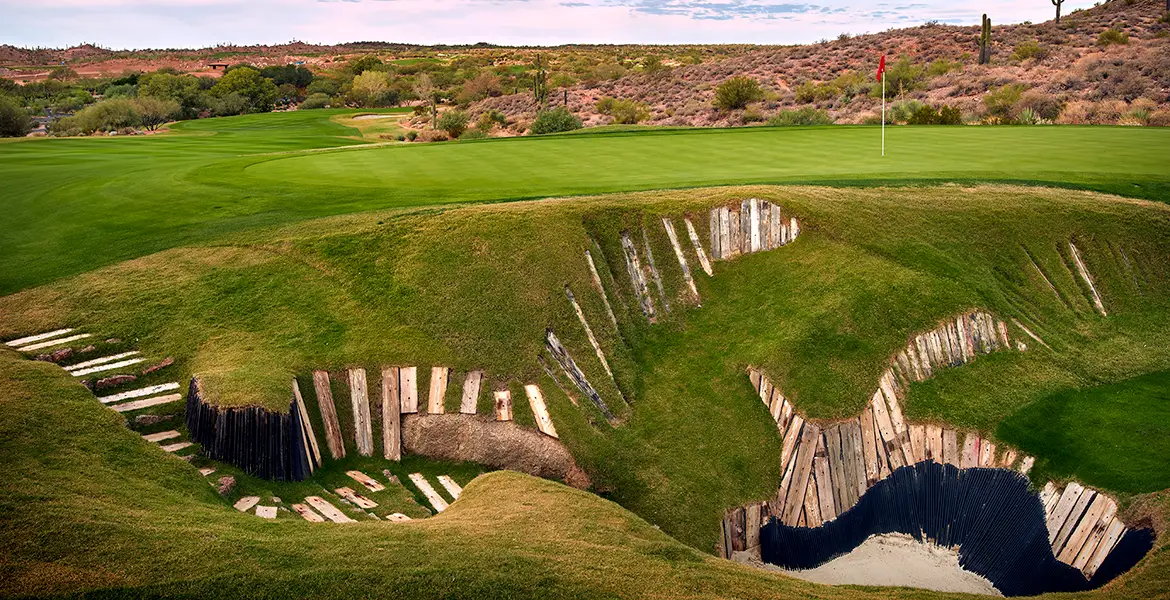
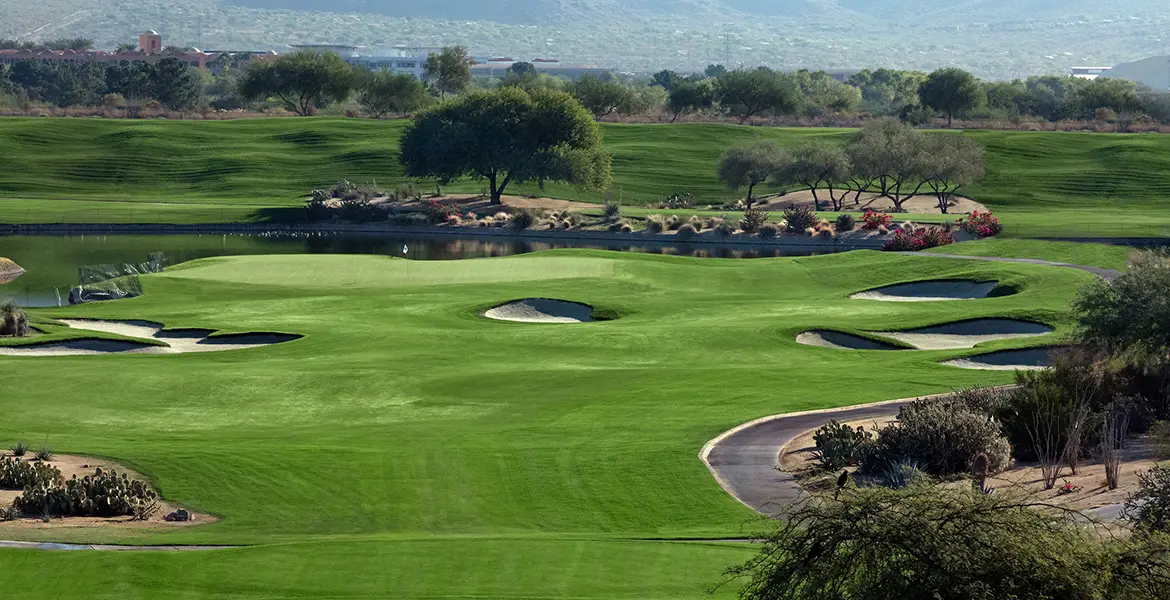
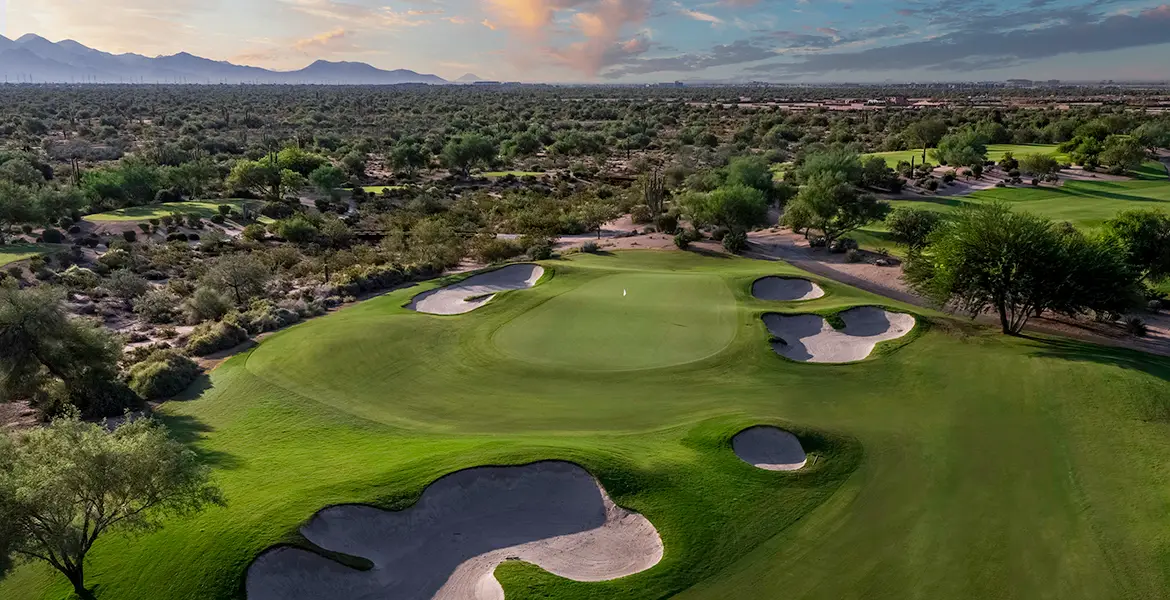
Think of desert golf and the chances are you picture somewhere in Arizona—Scottsdale, specifically. There, on the high-end courses at least, you’ll find brilliant fairways bordering sandy, rocky areas where the native vegetation might include saguaro, cholla, and prickly pear cacti; mesquite, palo verde, and ironwood trees; ocotillo; and yucca. The bunkers will typically be large and beautifully sculpted, the smooth greens similarly spacious.
But while the Sonoran Desert in Arizona, and also California, might be the first place that comes to mind and have by far the greatest concentration of desert golf, there are other deserts in the U.S. and around the world where the game is played.
America’s Mojave, Chihuahuan, and Great Basin Deserts have their share of excellent golf, and the Colorado Plateau is also home to a handful of first-rate courses. Globally, the Arabian Desert (specifically its eastern extreme along the Persian Gulf) can claim a few courses of international repute, and you’ll even find some quality layouts in the Kalahari and Patagonian Deserts.
You’ll also hear the term “high desert” which is used to describe a more elevated region (still arid, but the vegetation is very different to that in the low desert, and the gap between daytime highs and nighttime lows can be considerable) rather than cite a specific desert. Parts of central Washington and central Oregon, in particular, are described as such, and some of the high-desert courses here—Gamble Sands, Pronghorn, Tetherow, Brasada Canyons, and Crosswater—are acclaimed far beyond their state boundaries.
But because we instinctively think of Scottsdale and the southwest of the United States when the subject of “desert golf” comes up, that was the focus when choosing the Mount Rushmore of desert courses.
Desert Forest—Carefree, Ariz.
Admittedly more private than most of the golf clubs we feature in our Mount Rushmore selections, Desert Forest warrants inclusion by virtue of its place in the evolution of desert golf. Designed by Robert “Red” Lawrence, an associate of William Flynn in the late 1920s, it opened in 1962 making it, most probably, the first course of its kind. It is located in the upscale, master-planned community of Carefree in Maricopa County, about half an hour north of Scottsdale, and was created without large earth-moving machines roughly two decades before the area’s golf boom really took hold. It is therefore as natural and unadorned a course as you’ll see in this part of the world and an absolute delight to play.
TPC Scottsdale (Stadium)—Scottsdale, Ariz.
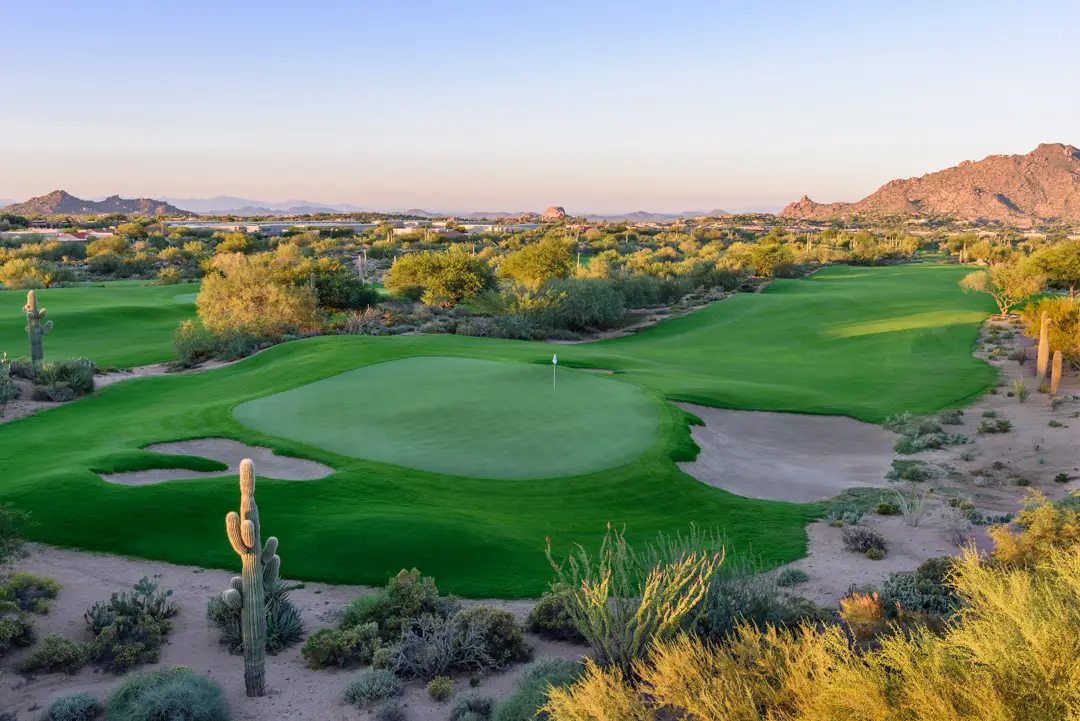
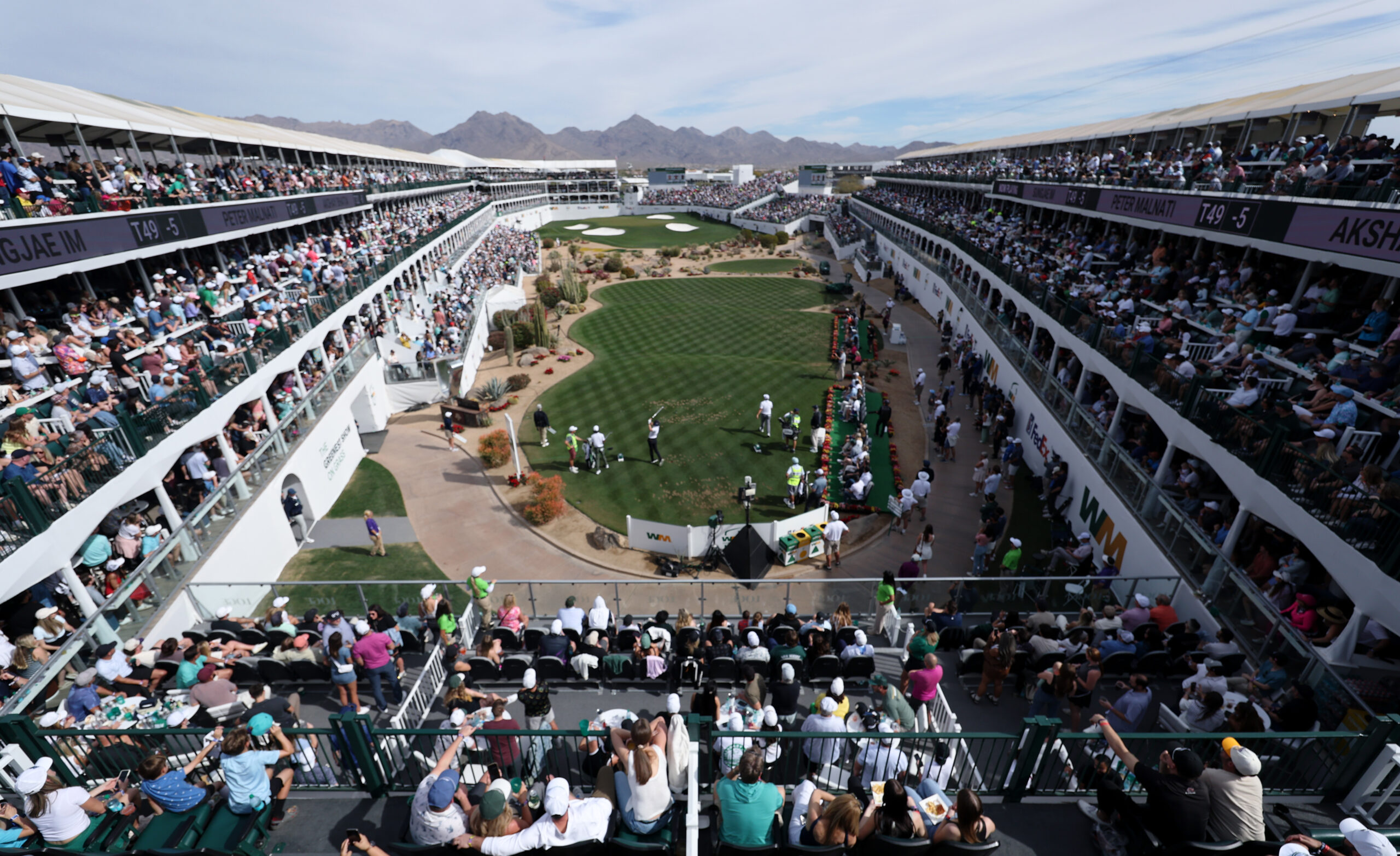
Regular readers know the courses that have appeared in our Mount Rushmore series aren’t necessarily what we consider to be the “best” in each category. If they were, TPC Scottsdale might be superseded by a number of others. What it has got that others don’t, of course, is celebrity. More than 600,000 people cram into the property during WM Phoenix Open week in early February, many of them to take up a spot somewhere around the par-three 16th hole where they are encouraged to make a lot of noise. That makes the course and event instantly recognizable, if a little notorious.
As it happens, TPC Scottsdale, designed by Tom Weiskopf and Jay Morrish and opened in 1986, is a very good course with plenty of excellent holes, most notably the exciting par-five 15th; the drivable par-four 17th where the left side of the green borders a lake and the back-left corner provides a thrilling pin-position; and the little par-three in between which isn’t actually that memorable a hole for 51 weeks of the year but invariably becomes the most famous hole in the world for a few days.
PGA West (Stadium)—La Quinta, Calif.
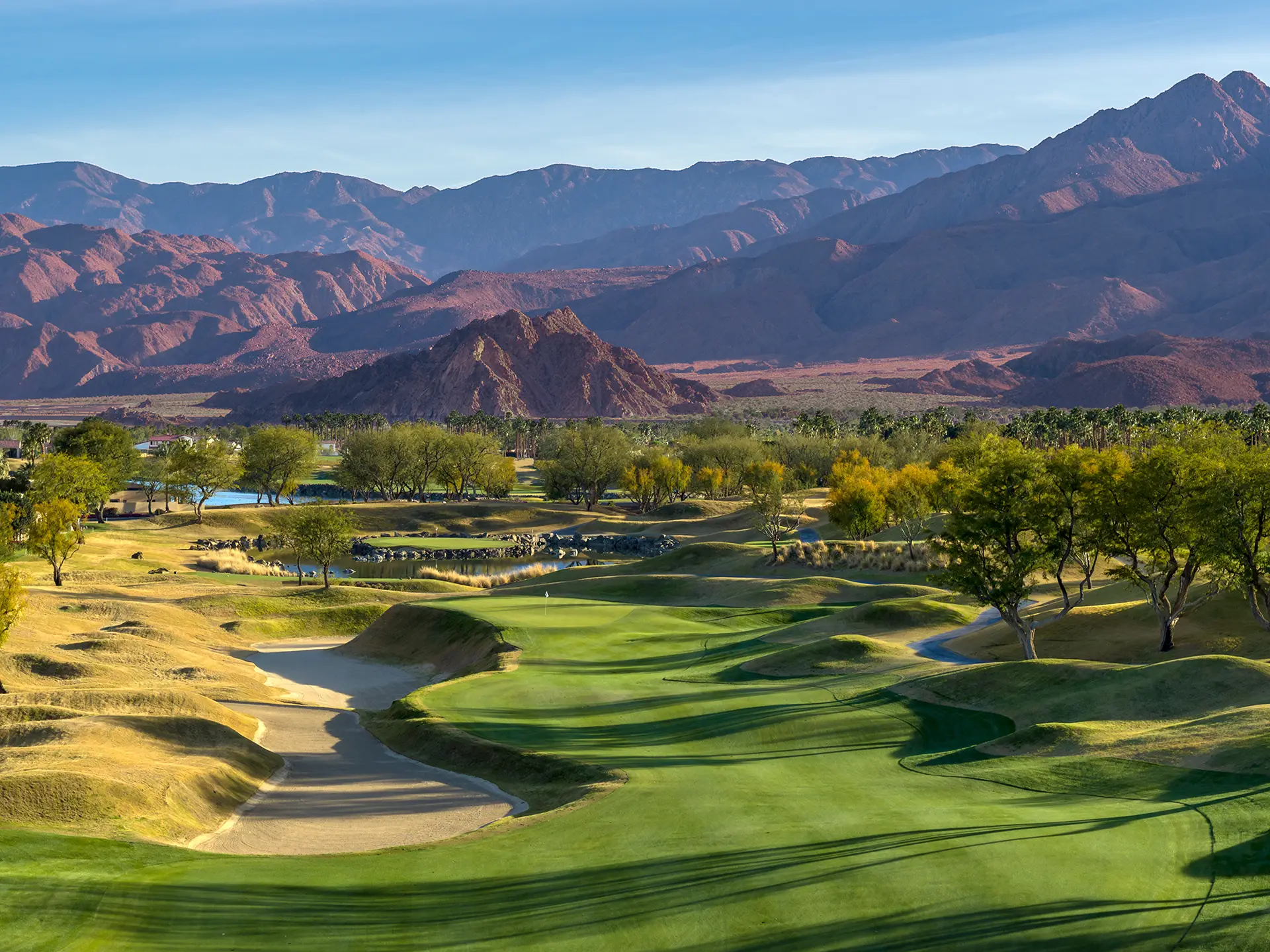
Talking of notoriety, Pete Dye’s Stadium course at PGA West was panned so vociferously by the pros after they first played it during the 90-hole Bob Hope Classic in 1987 that it was removed from the PGA Tour after only one year and didn’t return until the 2016 CareerBuilder Challenge (though it did host the Skins Game six times). With more square footage of water than fairway, and more bunker sand than putting surface, the Stadium course was extremely penal, though Dye’s clever use of contours, width, and angles meant it demanded plenty of strategy and patience, too. The course now plays at 7,210 yards for The American Express and, because of better equipment, better playing surfaces, and their improved athleticism, players now regard it as much less of a challenge than it once was. The Stadium course may have lost some of its sharpest teeth, but its fascinating past and collection of formidable holes earns it its place on the mountain.
Troon North (Monument)—Scottsdale, Ariz.
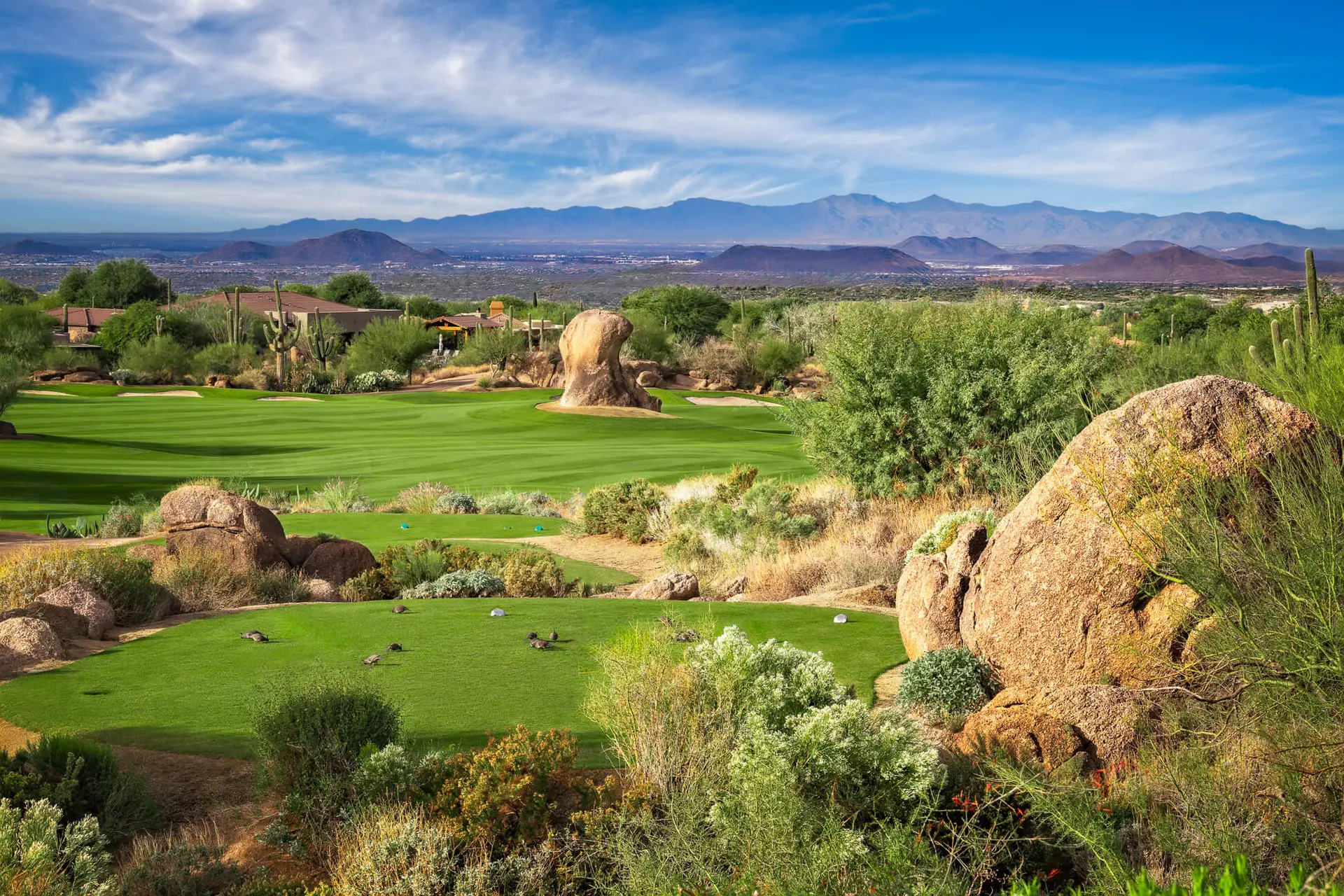
Again, readers will be able to point to higher-ranked courses, and certainly those with fewer houses around their perimeter. But the Monument is here because, for many, it might just be the quintessential desert golf course and the one that most epitomizes the genre. A Weiskopf/Morrish design that opened in 1990 (its sibling Pinnacle course opened five years later) that has since benefited from a rerouting and renovation, the Monument has all the elements you’d expect of a great desert course as well as terrific views of Pinnacle Peak. Thirty-six years after welcoming its first golfers, it remains one of Scottsdale’s finest high-end public courses.
What of Shadow Creek?
Yes, the Steve Wynn-developed, Tom Fazio design outside Las Vegas (it’s now owned by MGM Resorts international), is in the Mojave Desert and very highly ranked. But, with over 20,000 imported trees including willows, oaks, pines, and sycamores, the ultra-high-end fantasyland couldn’t look much less like an authentic desert course if it tried.
Technically, it is a desert course because it’s in a desert. But it’s not really a desert course… see?
Honorable Mention
Black Desert
Cabo Del Sol
Cascata
Desert Highlands
Desert Mountain (Geronimo)
Diamante (Dunes)
Emirates
Estancia
Indian Wells (Players and Celebrity)
Mission Hills
Quintero
Sand Hollow
We-Ko-Pa (Saguaro and Cholla)
Whisper Rock (Upper and Lower)
Wolf Creek